Mayor Zohran Mamdani has built a new political machine in less than a year in office, endorsing eight candidates in the June 23 primaries and winning all eight, a sweep City & State reports is stronger than any New York mayor has assembled in generations, a pattern City & State compares directly to Fiorello La Guardia's cultivation of socialist allies in the 1930s [1].
02
New York's state prison system paid $25.7 million to settle at least 170 lawsuits over five years, THE CITY found through a Freedom of Information Law request, with cases documenting officer beatings, medical neglect, and systematic retaliation against prisoners who filed complaints, and a camera rollout Governor Hochul promised two years ago that has reached 11 of 44 facilities [59].
03
The Rent Guidelines Board voted to freeze rents at 0% for all one- and two-year rent-stabilized leases beginning October 1, 2026, applying to roughly 1 million apartments citywide; the lone dissenting board member said the freeze is justified only if the city acts next to cut owners' operating costs, which it has not.
04
Mayor Mamdani and City Council Speaker Julie Menin were set to shake hands on the city budget Friday but Menin walked away from the table over the administration's refusal to expand the CityFHEPS rental voucher program, which has moved more than 26,000 households out of shelters in the last fiscal year, leaving the city without a budget deal ahead of the June 30 deadline.
05
The City Council's land use subcommittee unanimously approved Monitor Point, a 1,324-unit development on MTA-owned waterfront land in Greenpoint, with 662 affordable apartments including 110 units of supportive housing for formerly homeless New Yorkers, the product of five years of fights and last-minute negotiations that concluded "moments" before Council Member Lincoln Restler walked into the hearing.
Story: the same event, across the newsrooms that covered it
NYC Rent Freeze, 0% for Stabilized Apartments
The board froze rents on roughly 1 million apartments, and the one person who voted no says the math only works if the city acts next to control what landlords actually pay.
Within Housing & Real Estatethe internal split · 3 standpoints
All three outlets ran the same wire-style account from an amNewYork report on a June 26 Vital City forum where Gupta spoke publicly about his lone no vote.
The standpoints · tap any headline for the read
Housing & Real Estate“Lone RGB dissenter says there was no City Hall interference in rent freeze vote, but warns cost relief must follow”Bronx Times
“Unlike in previous years, there was no interference that I observed by the mayoral administration on decisions of individuals”
"Unlike in previous years, there was no interference that I observed by the mayoral administration on decisions of individuals," Gupta said, directly addressing Smyth's resignation claim that the vote had been fixed on the campaign trail. The Bronx Times gave equal weight to Gupta's process defense and his substantive warning: freeze after freeze, without property tax or insurance relief for owners, leaves buildings with capped revenue and uncapped costs. The piece captures the unusual position of an owner representative who voted yes, Wynn, arguing the freeze was economically sound for the most financially distressed buildings. [123]
Housing & Real Estate“Lone RGB dissenter says there was no City Hall interference in rent freeze vote, but warns cost relief must follow”Brooklyn Paper
“Everything since has been theater”
"Everything since has been theater," Smyth said in her resignation statement, characterizing the hearings and data review as a performance with a predetermined ending. Brooklyn Paper flagged that Smyth was an Adams appointee, providing the political context for her departure, and noted the Vital City forum gave Gupta his first public platform to explain his reasoning after the vote. [126]
Housing & Real Estate“Lone RGB dissenter says there was no City Hall interference in rent freeze vote, but warns cost relief must follow”QNS
Identical to the Bronx Times and Brooklyn Paper versions, which is notable primarily because Queens readers, in a borough with substantial stabilized stock in neighborhoods like Jackson Heights, Flushing, and Astoria, got no analysis of how the freeze lands there specifically. The story is the same across all three outlets. [131]
On June 25, the Rent Guidelines Board voted to approve 0% rent increases for one- and two-year leases on rent-stabilized apartments and lofts citywide, applying to leases beginning on or after October 1, 2026 through September 30, 2027. The vote passed with one dissent. The dissenter was Arpit Gupta, an associate professor of finance at NYU Stern and a public member of the board. One of the two owner representatives, Christina Smyth, resigned hours before the vote, alleging the outcome had been predetermined: "The Rent Guidelines Board has stopped being a fact-finding body. It has become a body that starts with an answer and vibes its way backward to justify it." The second owner representative, Maksim Wynn, voted in favor of the freeze, arguing that in buildings already under financial strain, raising legal rents might reduce actual collected income. RGB Chair Chantella Mitchell defended the decision, citing board data showing more than half of renter households in New York City are rent-burdened and nearly 30% severely rent-burdened, a 5.3% increase in operating costs, and a citywide vacancy rate of 1.41%, including 0.98% within the stabilized stock. [123][126][131]
The takeaway
--
Tammamdani Hall, Mamdani's New Political Machine
Zohran Mamdani won the mayor's office seven months ago and has already assembled a political operation that La Guardia, the mayor he most admires, would recognize.
1 of 9 desks covered thisNot covered by Public Safety & Justice, Housing & Real Estate, Transit & Streets, Business & Economy, Education, Health & Environment, Culture, Food & Nightlife, Sports
What each newsroom noticed · tap any headline for the read
Politics & Government“The rise of Tammamdani Hall”City & State New York
“Since winning the mayoral election, Mamdani has become the boss of a new political machine, one stronger than any mayor has had in generations.”
"Since winning the mayoral election, Mamdani has become the boss of a new political machine, one stronger than any mayor has had in generations." City & State is as interested in the mechanics as the outcome: the Union Square Cafe recruitment dinner, the DSA tension around Lander, the way Mamdani coordinated with political adviser Morris Katz and former communications director Andrew Bard Epstein to shape the primary field. The piece catches what the endorsements were worth in practice, the mayor appearing in "countless videos," speaking at fundraisers, joining canvasses and phone banks, and frames the Lander pick as the most politically sensitive call, crossing his DSA base to back a preferred ally. [1]
City & State published a detailed account of how Mayor Mamdani, since winning in November 2025, has systematically built a political operation spanning the mayor's office, NYC-DSA, and the Working Families Party. He endorsed eight candidates in the June 23 primaries, including Brad Lander for Congress in the 10th District, Assembly Member Claire Valdez for the 7th Congressional District, and five state legislative candidates, and all eight won. He personally recruited Valdez at a dinner at Union Square Cafe, where he showed up partway through to pitch her on running for Congress after only one year in the Assembly. The Lander endorsement required maneuvering DSA's preferred candidate, Council Member Alexa Avilés, out of the race, a significant internal tension given Mamdani's DSA roots, and Avilés dropped out the same day Lander announced. City & State draws the comparison to Fiorello La Guardia's 1934 backing of socialist congressional candidate Vito Marcantonio in East Harlem, framing what Mamdani is doing as historically rare for a New York mayor. [1]
The takeaway
--
Monitor Point Approval, Greenpoint Waterfront
The City Council committee approved 1,324 apartments on MTA-owned land, half affordable, including 110 for formerly homeless New Yorkers, after five years of fights that came down to a deal struck "moments" before the hearing started.
1 of 9 desks covered thisNot covered by Politics & Government, Public Safety & Justice, Transit & Streets, Business & Economy, Education, Health & Environment, Culture, Food & Nightlife, Sports
What each newsroom noticed · tap any headline for the read
Housing & Real Estate“Monitor Point approved by Council committee after affordable housing negotiations”Brooklyn Paper
“I thought this project was a total nonstarter, and it's come an extraordinarily long way”
"I thought this project was a total nonstarter, and it's come an extraordinarily long way," said Council Member Lincoln Restler, who represents the district. Brooklyn Paper, the closest outlet to this story geographically, gave it the most detailed treatment, including the specific AMI breakdowns and the fact that negotiations concluded moments before Restler walked into the hearing. The piece does not downplay opposition: Save The Inlet called the waterfront "sacrificed to oversized private development," noting the site sits in a FEMA Special Flood Hazard zone and a migratory bird corridor. The paper also catches that the market-rate half of the building, studios at $4,000, three-bedrooms at $9,500, is the income that cross-subsidizes the affordable half, making clear who is being served and by whom. [113]
On June 25, the City Council's Subcommittee on Zoning and Franchises unanimously approved the Monitor Point development at 40 Quay Street in Greenpoint, just north of Bushwick Inlet Park. The Gotham Organization, selected by the MTA after a 2021 RFP, originally proposed 1,150 total units with 400 affordable apartments at 40-80% of Area Median Income. After last-minute negotiations, the project grew to 1,324 apartments, with 662 affordable, including units at 50% AMI (a family of three earning $76,350 can rent a two-bedroom for $1,822/month), 172 moderate-income units at 80-120% AMI, and 110 units of supportive housing for formerly homeless residents. Senior affordable housing starts at $911 a month for a one-bedroom. Market-rate units begin at roughly $4,000 for a studio and reach $9,500 for three bedrooms. The MTA will receive approximately $39 million over the first 25 years of the lease and will use those funds to make the Nassau Avenue G train station ADA-accessible. Gotham will donate $300,000 annually to Bushwick Inlet Park maintenance, and Mayor Mamdani told Council Member Restler he is committed to completing the park. The Land Use Committee also approved the project unanimously; full Council passage is expected. [113]
The takeaway
--
New York Prison Abuse, $25.7 Million in Settlements
New York's state prison system paid $25.7 million to settle 170 abuse lawsuits in five years, a paper trail of officer beatings, medical neglect, and retaliation that existed years before two guards killed a prisoner on camera.
1 of 9 desks covered thisNot covered by Politics & Government, Housing & Real Estate, Transit & Streets, Business & Economy, Education, Health & Environment, Culture, Food & Nightlife, Sports
What each newsroom noticed · tap any headline for the read
Public Safety & Justice“The Price of Prison Abuse: $25.7 Million in New York Settlements”The City Reporter
“I sue the state all the time and twice on Sunday”
"I sue the state all the time and twice on Sunday," said attorney Brian Dratch, who has represented dozens of incarcerated people and told THE CITY his caseload has only increased over 15 years in this practice. THE CITY framed this as a rare, data-driven look inside a system that ordinarily shields its records. The piece connects the settlement pattern to the 2024 guard killings of Brooks and Nantwi, positioning the $25.7 million as evidence of chronic failure rather than isolated incidents. Corrections expert Dean Williams's line carries the story: "When allegations repeatedly surface involving excessive force, medical neglect, or other misconduct, the issue becomes harder to dismiss as a series of isolated incidents. It's the pattern and consistency of the dysfunction." [59]
THE CITY obtained records through a Freedom of Information Law request of at least 170 lawsuits against the New York State prison system resulting in settlements totaling $25.7 million over five years. The settlements cover officer assaults, medical neglect, and failures to protect prisoners. Antoine Galloway, a Harlem man serving time at Clinton Correctional Facility, received $150,000 after seven officers beat him in 2016 following a sexual assault grievance he had filed against a guard; he said he blacked out twice. In a separate case, the state paid $850,000 after a Green Haven officer slammed Melvin Virgil's head into a wall while handcuffed, body camera footage contradicted the officers' written accounts, and one officer pleaded guilty to a federal charge. At least 13 cases were classified as medical malpractice, costing nearly $3.8 million; one prisoner had a testicle removed after staff delayed treatment for a week; another entered prison at age 20 and was not diagnosed with Stage 4 cancer despite visible symptoms including neck lumps and dramatic weight loss. Roughly 71 cases closed in 2024 and another 71 in 2025. Governor Hochul promised security cameras in all 44 state correctional facilities following the deaths of prisoners Robert Brooks and Messiah Nantwi at the hands of guards; 11 facilities have been fitted so far, with others in various stages of design or construction. [59]
The takeaway
--
CityFHEPS Budget Fight Stalls NYC Budget
Mamdani campaigned on expanding the city's rental voucher program, then continued his predecessor's lawsuit against it, and now the fight is holding up the entire city budget as 7,700 federal vouchers expire.
1 of 9 desks covered thisNot covered by Public Safety & Justice, Transit & Streets, Business & Economy, Education, Health & Environment, Culture, Food & Nightlife, Sports
What each newsroom noticed · tap any headline for the read
Housing & Real Estate“Pressure mounts on Mamdani over expanding housing voucher program in budget talks”Gothamist
“Municipal budgets are no replacement for the federal balance sheet”
"Municipal budgets are no replacement for the federal balance sheet," said Paul Williams, a housing policy expert who served on Mamdani's own transition team. Gothamist played this as a tension between Mamdani the candidate and Mamdani the mayor managing a $5 billion deficit, and was explicit that his administration has not dropped the Adams-era legal challenge it promised to drop. The piece gave the cost projections from the Citizens Budget Commission and the comptroller's office prominent placement alongside WIN's shelter-savings argument, which is the correct framing: this fight is specifically about what price the city will pay and who decides. Sanchez's assessment that both sides are "working in good faith" suggests this is a dispute about dollars, not values. [99]
Budget negotiations between Mayor Mamdani and City Council Speaker Julie Menin stalled Friday over the CityFHEPS rental voucher program, which allows recipients to pay 30% of their income toward rent with the city covering the rest. More than 26,000 households used it to exit shelters in the last fiscal year. The Council passed laws in 2023 expanding the program; the Adams administration sued to block them. Mamdani, who campaigned on dropping the suit, instead appealed it to the state's highest court in March 2026. Menin held a City Hall steps rally Friday rather than joining Mamdani for a budget handshake. "We would have had a handshake on Friday and we would've been all set, all systems go to vote on a budget tomorrow, had it not been for this disagreement," said Councilmember Pierina Sanchez, chair of the housing committee. The Citizens Budget Commission projects the program at $1.7 billion in FY2026 and estimates an expanded program would cost between $4.7 billion and $9.6 billion by FY2030. The city comptroller's office projects the expansion could cost an additional $6 billion to $22 billion over five years. Family shelter provider WIN estimates the expansion would save $635 million in shelter costs over five years. The federal Emergency Housing Voucher program, which has kept 7,700 New York City households stably housed, is also ending. [99]
The takeaway
--
Foster Care Prevention Cuts, Brownsville and Bushwick
The mayor's budget cuts $2.7 million from foster prevention services in Brooklyn and Queens, programs designed to keep families together before a child enters the system, and the city's own matching math means the real loss is larger than the line item.
1 of 9 desks covered thisNot covered by Politics & Government, Housing & Real Estate, Transit & Streets, Business & Economy, Education, Health & Environment, Culture, Food & Nightlife, Sports
What each newsroom noticed · tap any headline for the read
Public Safety & Justice“NYC programs meant to keep kids out of foster care could lose millions of dollars”Gothamist
“seamless transitions”
"There is no way that families who are already vulnerable, families who already don't trust the system, are now going to say, 'All right, well, it's slots over here, so I'm gonna go,'" said Council Member Althea Stevens, chair of the Committee on Children and Youth. Gothamist identified the specific programs and neighborhoods affected, connected the human story of Evans and her son to the policy numbers, and noted that ACS's testimony about "seamless transitions" drew pointed pushback from Stevens, who said plainly: "Whether we like to say it or not, there's going to be harm." The piece caught a detail worth noting: prevention organizations were already struggling to retain staff with competitive salaries before these cuts. [109]
Mayor Mamdani's proposed budget recommends cutting approximately $2.7 million from foster care prevention organizations, following a directive requiring all city agencies to identify ways to reduce spending. The cuts would end city funding for programs at CAMBA (in Brownsville and Bushwick), Good Shepherd Services, Forestdale, and the Coalition for Hispanic Family Services in several Brooklyn and Queens neighborhoods. Because the state reimburses prevention services based on local investment, the city's cut triggers a larger total loss in combined funding. The reductions would eliminate 360 family slots and affect 49 employees. Organizations are already rescinding job offers and moving toward layoffs. ACS Deputy Commissioner Luisa Linares told the Council it was "a very difficult decision" based on utilization data by neighborhood. ACS said more than 10,000 prevention slots would remain citywide. CAMBA is currently serving Felicia Evans, who lost everything in a Brownsville house fire in February and was at risk of losing her 10-year-old son Mason to the child welfare system; CAMBA staff have helped stabilize the family and keep Mason in school. The city's fiscal year ends June 30. [109]
The takeaway
--
Around the Boroughs
Bronx (Van Cortlandt Park): Van Cortlandt Park Stadium, closed since 2021, cannot be repaired, it sits on unstable landfill, has asbestos, lead, and PCBs throughout, and has a foundation so shallow it would need to be rebuilt anyway. NYC Parks has no demolition funding, no contractor estimate, and the handball courts next to it could eventually close too. [95]
Bronx: Rep. Ritchie Torres sent a letter to the Department of Justice urging it to reconsider a June 18 memo reinterpreting the 1999 Olmstead decision, which had protected disabled people's right to community-based care over institutionalization. The Bronx has the city's highest concentration of people with disabilities; New York state officials say nothing has changed locally, but advocates are alarmed. [94]
Brooklyn (Vinegar Hill): Alloy Development's 240 Nassau Street proposal, 1,500 rental apartments, 300 affordable, a new K-8 public school, and a home for the Cultural Museum of African Art, enters the ULURP public review process next month. The site was the Madison Square Boys' and Girls' Club Navy Yard Clubhouse before Alloy bought it in 2023. [120]
Brooklyn (Coney Island): Joey Chestnut returns to defend his Nathan's Famous Hot Dog Eating Championship title at Surf and Stillwell on July 4 at noon, chasing his world record of 76. Miki Sudo defends the women's title. The contest has run at Coney Island since 1916. [114]
Brooklyn (Bay Ridge): Dozens of tall ships from 46 countries pass through the Verrazzano-Narrows Bridge beginning at 9:30 a.m. on July 4 as part of Sail4th 250, with Blue Angels at 10:15 a.m. Bay Ridge gets the best water-level view in the city. [114]
Brooklyn (Greenwood Heights): Green-Wood Cemetery runs full-day America250 programming July 4, including a trolley tour on "Brooklyn's Black Trailblazers" honoring Jean-Michel Basquiat, Grace Nail Johnson, and James Weldon Johnson. Walking tours and family trolley rides run from 10 a.m. to 5:30 p.m. [114]
Brooklyn (Dumbo): Time Out Market is hosting a rooftop Fourth of July party, 5 to 11 p.m., ticketed, with DJ Fatfingaz and a front-row view of Macy's fireworks from 55 Water Street. Portions of Water and Old Fulton streets close to traffic. [114]
Manhattan (Upper East Side): The Torkian Group revealed a 30-story, 70-unit rental tower at 301 East 71st Street at Second Avenue, near the Q train's 72nd Street station. Eighteen units will be affordable at 60% AMI, spread across the full height of the building rather than clustered. No construction timeline yet. [121]
Citywide: Macy's 50th anniversary fireworks launch from the Brooklyn Bridge and East River on July 4, with a Hudson River component added for the first time in years. The mayor's office is distributing 100,000 free priority-viewing passes. USPS closes Saturday and Sunday; Costco closes July 4 but opens July 3. [11]
Brooklyn (Flatbush/Barclays area): Mikal Bridges, the Knicks acquisition that cost a record-setting draft pick haul and drew years of scrutiny, is an NBA champion. A Posting and Toasting profile traced his path from Phoenix to Brooklyn to the title, noting he absorbed pressure that would have broken most players. [245]
Queens (various): The Mets ended a seven-game losing streak Sunday, beating the Phillies 6-2 at home behind four sixth-inning runs and two more in the seventh, interim manager Andy Green's first win, with Christian Scott activated to start. [211]
Bronx (Yankee Stadium area): The Red Sox completed a four-game sweep of the Yankees in Boston on Sunday, 5-4 in extras, with Aroldis Chapman blowing a save against his former team in the ninth. The Yankees are now 1-15 in June games at Fenway since 2019; every other month they're 23-15 there. [234]
Brooklyn (Barclays Center): The Nets introduce three draft picks Monday at the Brooklyn Basketball Training Center, including Micbael Brown Jr., 20 years old and already calling himself a future all-time great. Sean Marks will be at the podium. [231]
Citywide (Haitian diaspora): The Haitian Times reflected on Haiti's 0-3-0 World Cup exit, arguing that the diaspora's impassioned response revealed a structural gap: scattered individual support without the organized travel networks and supporter infrastructure that nations like Scotland built over generations. [66]
Only in New York
Photo: qns
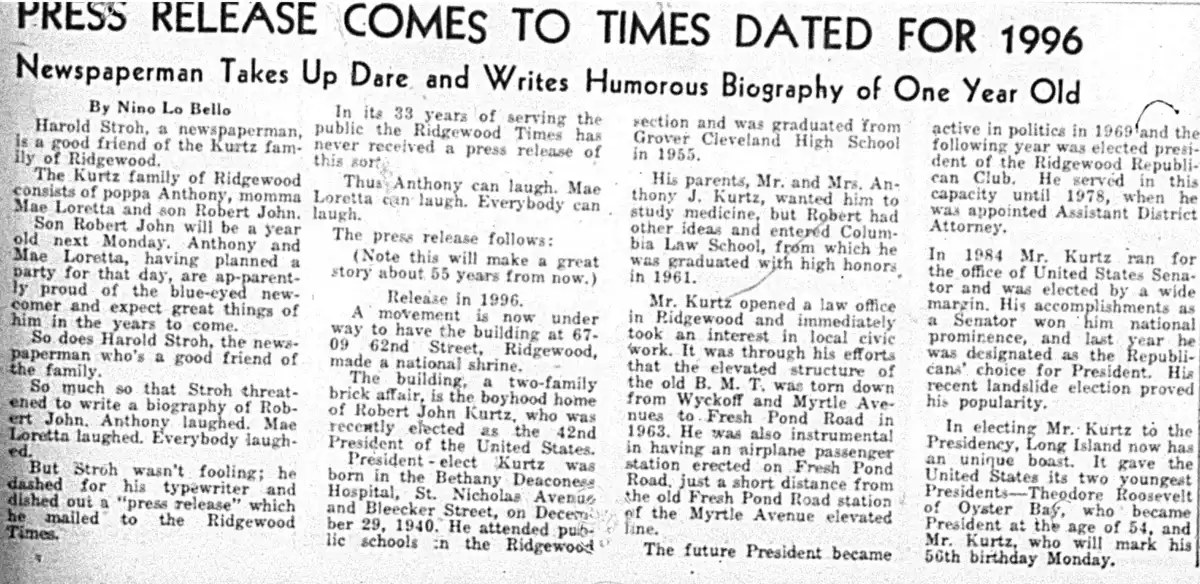
In December 1941, with Pearl Harbor six weeks fresh and the front pages of every Ridgewood newspaper full of air warden registrations and civilian defense calls, a local man named Harold Stroh sat down at his typewriter on a dare. His neighbors, the Kurtzes of 67-09 62nd Street, had just celebrated their son Robert John's first birthday. Harold figured the boy looked presidential. So he banged out a press release dated 55 years in the future and mailed it to the Ridgewood Times, which ran it. It described Robert John Kurtz's graduation from Columbia Law School with high honors in 1961, his opening of a law office in Ridgewood, his dismantling of the BMT elevated on Wyckoff and Myrtle avenues by 1963 (the neighborhood had long wanted it gone), his election to the U.S. Senate in 1984, and his landslide presidential victory in 1996 as the Republican nominee. The whole neighborhood laughed. The Ridgewood Times had never received a press release of that kind in its 33 years. Robert John Kurtz did not become the 42nd president; Bill Clinton did. QNS ran the old column this week and reported that no one knows what happened to the boy from 62nd Street. If you grew up in Ridgewood and you know, they'd like to hear from you. [45]