
The Colonial City & the Revolution · 1776 to 1783
The Prison Ships
On rotting hulks in the bay off Brooklyn, the British held captured Americans in conditions so lethal that more died there than in all the battles of the Revolution.
The facts
- Where
- Wallabout Bay, off the Brooklyn shore, now the Brooklyn Navy Yard
- The ships
- About sixteen decommissioned hulks, the HMS Jersey the most notorious
- Who
- Captured American soldiers, sailors, and privateers
- The toll (estimated)
- Roughly 11,500 died, more than in all the war’s battles combined
- The killers
- Disease and starvation, not the gallows: dysentery, smallpox, yellow fever, foul water
- The memorial
- The Prison Ship Martyrs’ Monument in Fort Greene Park, dedicated 1908
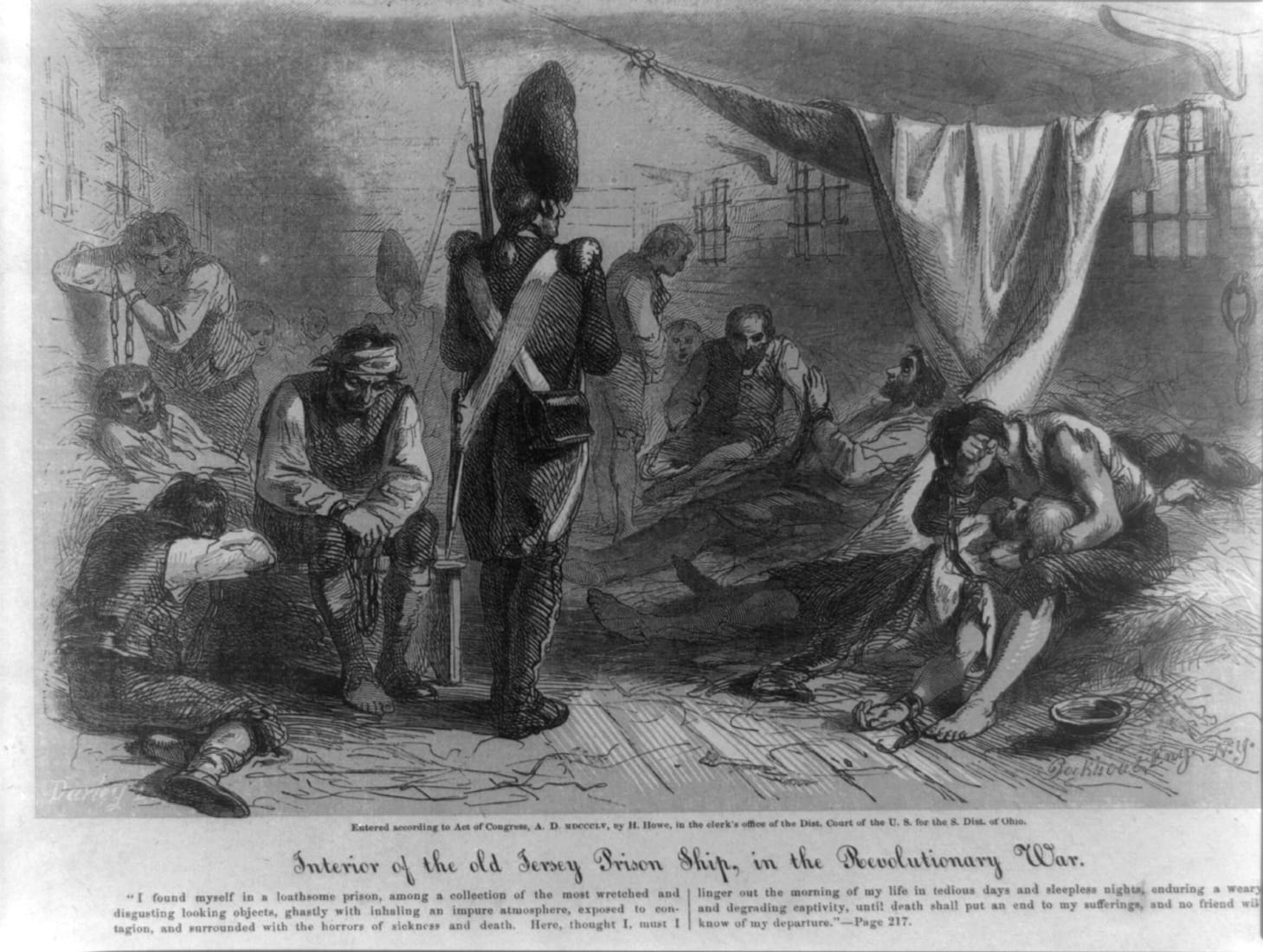
The cruelest place in Revolutionary New York was a fleet of rotting ships. After the British took the city in 1776, they crammed captured Americans, especially sailors and privateers, into decommissioned hulks moored in Wallabout Bay off Brooklyn. The worst was the HMS Jersey, a former 60-gun warship that held more than a thousand men at a time in a hold built for a few hundred. The killers were disease and hunger: dysentery, smallpox, yellow fever, foul water, and a deliberate policy of starving prisoners until they agreed to join the British army. Every morning the guards called the living up with the cry "Rebels, turn out your dead." The estimate, and it is an estimate, is that some 11,500 Americans died on the ships, more than fell in every battle of the war combined. Their bones washed up on the Brooklyn shore for decades, and now rest in a crypt under a granite column in Fort Greene Park.
In their words
The event in the voices and documents of the people who were there. Every source links out so you can check it.
-
Newspaper
A contemporaneous, real-time record of the morning routine and the daily death count, not a later memory.
Our morning’s salutation is, "Rebels! Turn out your dead!" ... we bury 6, 7, 8, 9, 10 and 11 prisoners a day.
An anonymous prisoner’s letter aboard the HMS Jersey, printed in the Continental Journal, August 23, 1781
Source: Readex / America’s Historical Newspapers -
Memoir
Dring’s is the fullest surviving eyewitness account. This is his first night driven below decks.
Surrounded by I knew not whom, except that they were beings as wretched as myself; with dismal sounds meeting my ears from every direction; a nauseous and putrid atmosphere filling my lungs at every breath.
Captain Thomas Dring, Recollections of the Jersey Prison-Ship (prisoner 1782, published 1829)
Source: American Prisoners of the Revolution (Dandridge) -
Memoir
Fox names the strategy behind the suffering: starve the prisoners until they switch sides.
Many were actually starved to death in hope of making them enroll themselves in the British Army.
Ebenezer Fox, imprisoned on the Jersey as a teenager in 1781 (memoir, 1847)
Source: Journal of the American Revolution -
Memoir
Andros, a prisoner who later became a clergyman, gives the most-quoted line on the ship’s lethality.
The Jersey ... contained pestilence sufficient to desolate a world; disease and death were wrought into her very timbers.
Thomas Andros, The Old Jersey Captive, 1833
Source: Journal of the American Revolution -
Document
The dead were buried in the sand of the bay and surfaced for decades. Gathering them became an act of civic memory.
After the war, human bones washed up along the Wallabout shore for years. The Brooklyn landowner John Jackson and the Tammany Society gathered roughly twenty hogsheads of remains and reburied them in 1808.
The collection of the martyrs’ remains, beginning 1808
Source: American Prisoners of the Revolution -
Document
The largest single monument to the Revolution in the city honors the prisoners, not a general or a battle.
The Prison Ship Martyrs’ Monument, a 149-foot granite column designed by Stanford White, was dedicated in Fort Greene Park on November 14, 1908, with President-elect William Howard Taft as the principal speaker. A crypt beneath it holds a fraction of the dead.
The Prison Ship Martyrs’ Monument, Fort Greene Park, dedicated 1908
Source: NYC Parks; records collected
What people get wrong
-
The myth The 11,500 death toll is a hard count.
What’s true It is an estimate. No complete register survives, and figures range up to 18,000. What is firm is the comparison: far more Americans died on the prison ships than the roughly 4,400 killed in all the battles of the war.
-
The myth The prisoners were mostly executed or killed by violence.
What’s true The overwhelming killers were disease and starvation: dysentery, smallpox, yellow fever, foul water, and suffocating overcrowding. The cruelty was in the conditions, and in the policy of starving men until they enlisted with the Crown.
-
The myth The monument holds all the martyrs’ remains.
What’s true The crypt holds only a small fraction, bone fragments gathered from the shore. Most of the dead were never recovered.
What it changed
- More Americans are estimated to have died on the Brooklyn prison ships than in all the battles of the Revolution combined.
- Captain Thomas Dring’s Recollections of the Jersey Prison-Ship (1829) remains the standard eyewitness account, still in print.
- The remains were moved to Fort Greene Park in 1873, and the Prison Ship Martyrs’ Monument was raised over them in 1908.
- The HMS Jersey’s own remains were rediscovered in 1902 during construction at the Brooklyn Navy Yard.
The New York Shelf
Read the whole story
Paid link. If you buy a book through this link, Bookshop.org pays us a small commission and sends a share of the sale to independent bookstores.
-
The history
Forgotten Patriots (opens Bookshop.org)
Edwin G. Burrows · 2008
Burrows documents the British prison ships and jails in occupied New York, where thousands of American captives died, and what happened to the survivors.

The city is still writing this.
Four centuries end at this morning’s news. The daily brief picks up where the history leaves off: what changed in New York today and what it means, explained by breakfast.
Free. One email each morning. One-click unsubscribe. Never sold.