
1664–1783
The Colonial City & the Revolution
A century under the British crown that ended in revolution. The city gave America an early case for a free press, a panic that sent dozens to the gallows and the stake, a brutal seven-year occupation, and Washington’s tearful goodbye in a Pearl Street tavern.
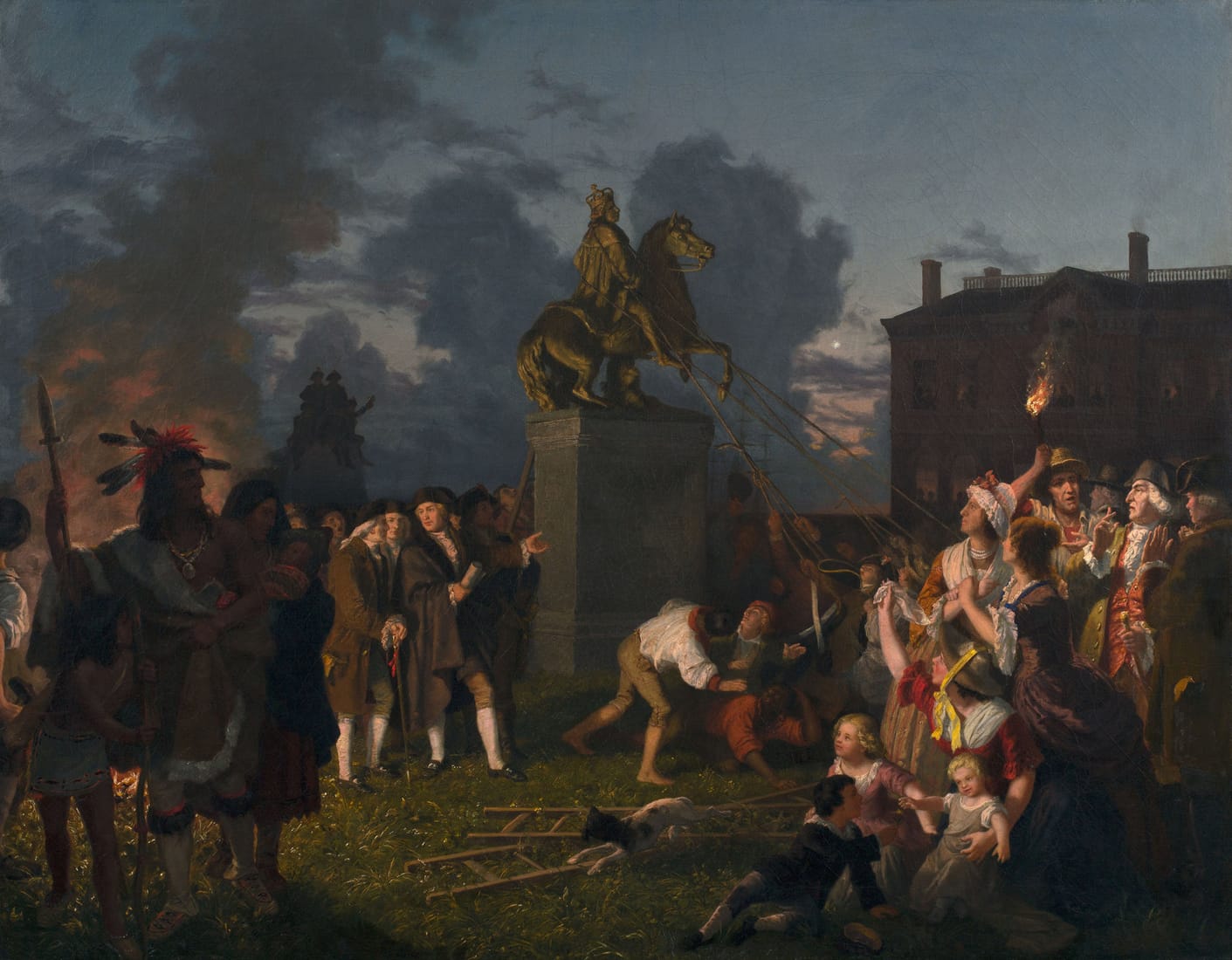
- 1735
August 4, 1735
Zenger Acquitted, Press Freed
A New York jury defied the judge and acquitted Zenger of seditious libel for printing criticism of the royal governor.
The question before the Court... is not the cause of one poor printer, nor of New-York alone... It is the best cause. It is the cause of liberty.
Andrew Hamilton, closing address to the jury defending printer John Peter Zenger; recorded in James Alexander’s "Brief Narrative" (1736)It didn’t change the law for decades. But it planted the idea that a jury could protect a printer who told the truth.
Source: Historical Society of the New York Courts Read the full story - 1741
1741
The Slave "Conspiracy" Trials
On an island where the enslaved were perhaps a fifth of the population, a wave of arson fears triggered mass arrests and executions on evidence now regarded as coerced.
After a series of fires, New York’s courts tried scores of enslaved and poor people for a plot to burn the city. By the judge’s own published record, about 30 people were executed — roughly 13 burned at the stake and 17 hanged — and some 70 more were sold out of the colony.
Daniel Horsmanden, a presiding justice, "A Journal of the Proceedings in the Detection of the Conspiracy" (1744)
Whether any plot existed is still debated. The fullest record we have was written by the judge who sent people to the stake.
Source: Gilder Lehrman Institute Read the full story - 1765
October 19, 1765
No Taxation Without Consent
Nine colonies sent delegates to New York to draft the first unified protest against Parliament’s taxes, an early "no taxation without representation."
It is inseparably essential to the freedom of a people, and the undoubted right of Englishmen, that no taxes be imposed on them, but with their own consent, given personally, or by their representatives.
Declaration of Rights and Grievances, adopted by the Stamp Act Congress at New York’s City Hall, October 1765It was still deferential, affirming "all due subordination" to Parliament even as it denied Parliament’s power to tax. The break was a decade off.
Source: Teaching American History Read the full story - 1776
July 9, 1776
The King Comes Down
Washington had the Declaration read to his army on the Common; that night a crowd toppled the gilded statue of George III at Bowling Green and melted much of its lead into musket balls.
The declaration of Congress, shewing the grounds & reasons of this measure, is to be read with an audible voice. The General hopes this important Event will serve as a fresh incentive to every officer, and soldier, to act with Fidelity and Courage.
George Washington, General Orders, New York, July 9, 1776Washington’s very next orders scolded the soldiers for the unauthorized vandalism. Even a revolution wanted discipline.
Source: Founders Online (National Archives) - 1776
August 27–30, 1776
The Battle of Brooklyn
The largest battle of the entire Revolution was fought across Brooklyn and lost in a morning. Two nights later, 9,000 Americans were rowed off Long Island in silence, and a dawn fog hid the last boats.
At this time a very dense fog began to rise, and it seemed to settle in a peculiar manner over both encampments. I recollect this peculiar providential occurrence perfectly well; and so very dense was the atmosphere that I could scarcely discern a man at six yards’ distance.
Benjamin Tallmadge, who crossed with the rear guard, on the fog that covered Washington’s escape across the East River ("Memoir," 1858)Washington lost the field, the passes, and over 1,000 prisoners, but not the army. New York stayed British for the rest of the war.
Source: Memoir of Col. Benjamin Tallmadge (Internet Archive) Read the full story - 1776
September 21, 1776
Manhattan Burns
Days after the British took the city, a fire destroyed perhaps a quarter of it, including Trinity Church.
The appearance of the Trinity Church when completely in flames was a very grand sight, for the Spire being entirely framed of wood and covered with shingles, a lofty Pyramid of fire appeared... until the whole fell with a great noise.
Capt. Frederick Mackenzie, British officer, diary, September 21, 1776Who set it was never settled. The British blamed rebel arsonists; Washington privately noted that Providence had done what Congress wouldn’t let him. St. Paul’s Chapel survived and still stands.
Source: Diary of Frederick Mackenzie (Internet Archive) - 1781
1781
Rebels, Turn Out Your Dead
On rotting hulks in Wallabout Bay off Brooklyn, the British held captured American sailors in conditions so lethal that more Americans likely died on the prison ships than in all the war’s battles.
Rebels! Turn out your dead!
The morning cry of the guards aboard the prison ship Jersey, in a prisoner’s letter printed in the Continental Journal (Boston), August 23, 1781The dead were later gathered into the Prison Ship Martyrs’ Monument that still stands in Fort Greene Park.
Source: Readex / America’s Historical Newspapers Read the full story - 1783
December 4, 1783
Washington’s Farewell
Nine days after the British sailed away on Evacuation Day, Washington said goodbye to his officers in the Long Room of Fraunces Tavern before leaving to resign his commission.
With a heart full of love and gratitude, I now take leave of you. I most devoutly wish that your latter days may be as prosperous and happy as your former ones have been glorious and honorable.
George Washington to his officers at Fraunces Tavern, as recalled by Benjamin Tallmadge, who was in the room ("Memoir," 1858)This is the only firsthand account, written by Tallmadge nearly fifty years later. The exact words are a soldier’s memory, not a transcript, but the tears were real.
Source: Memoir of Col. Benjamin Tallmadge (Internet Archive) - 1712
April 6, 1712
Fire in Crook's Orchard
About twenty three enslaved New Yorkers armed themselves and gathered before dawn, the start of the only slave revolt in the colonial city's recorded history.
they agreed to meet in the orchard of M' Crook the middle of the Town, some provided with fire arms, some with swords and others with knives and hatchets, this was the sixth day of April, the time of meeting was about twelve or one o'clock in the night, when about three and twenty of them were got togeather
Governor Robert Hunter to the Lords of Trade, June 23, 1712Nine colonists were killed before soldiers and militia hunted the rebels down across Manhattan.
Source: Documents Relative to the Colonial History of the State of New York, ed. E. B. O'Callaghan, Vol. V (1855), p. 341 Read the full story
The New York Shelf
The book on this era
Paid links. If you buy a book through these links, Bookshop.org pays us a small commission and sends a share of the sale to independent bookstores.
-
The history
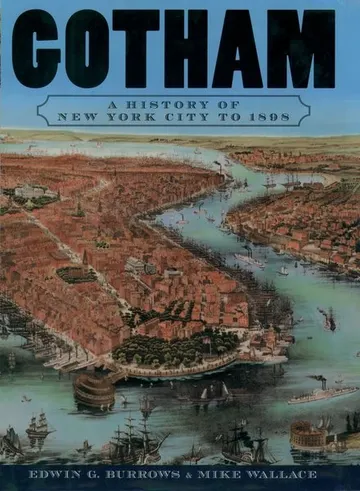
Gotham (opens Bookshop.org)
Edwin G. Burrows and Mike Wallace · 1999
Burrows and Wallace cover New York from its earliest settlement to consolidation in 1898, in a single volume of more than a thousand pages. It won the Pulitzer Prize for History.
-
The history
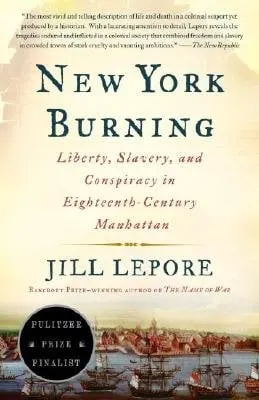
New York Burning (opens Bookshop.org)
Jill Lepore · 2005
Lepore reconstructs the fires and trials of 1741, when white New Yorkers accused enslaved people of plotting to burn the city and put dozens of them to death.
-
The history
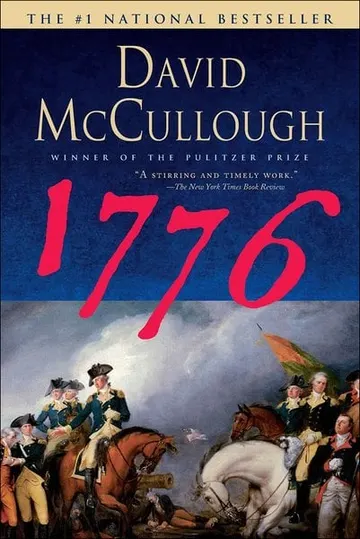
1776 (opens Bookshop.org)
David McCullough · 2005
McCullough tracks the year of the Declaration from the Siege of Boston through the Battle of Brooklyn and Washington's retreat across New York and New Jersey, with letters and diaries from both armies.
-
The history
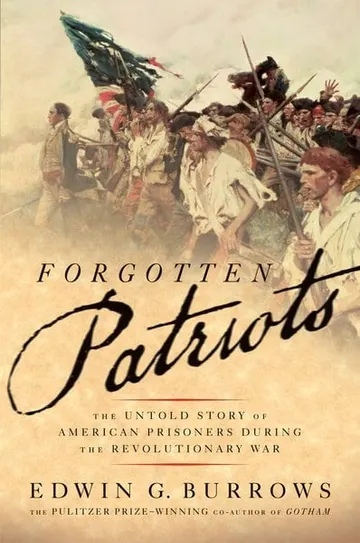
Forgotten Patriots (opens Bookshop.org)
Edwin G. Burrows · 2008
Burrows documents the British prison ships and jails in occupied New York, where thousands of American captives died, and what happened to the survivors.
The city is still writing this.
Four centuries end at this morning’s news. The daily brief picks up where the history leaves off: what changed in New York today and what it means, explained by breakfast.
Free. One email each morning. One-click unsubscribe. Never sold.