
The Colonial City & the Revolution · 1735
The Trial of John Peter Zenger
A New York jury freed a printer the law said was guilty, and planted the idea that became the free press. It changed no law for seventy years.
The facts
- When
- Tried and acquitted August 4, 1735; Zenger was jailed for nearly nine months first
- Where
- City Hall, Wall and Nassau Streets, the site of today’s Federal Hall
- The charge
- Seditious libel, for printing the New-York Weekly Journal’s attacks on royal governor William Cosby
- The verdict
- Not guilty, after the jury was out about ten minutes
- The catch
- Under the law of the day, truth was no defense. The jury acquitted anyway
- Key people
- Andrew Hamilton (defense), Chief Justice James DeLancey (who barred a truth defense), James Alexander (the Journal’s real author)
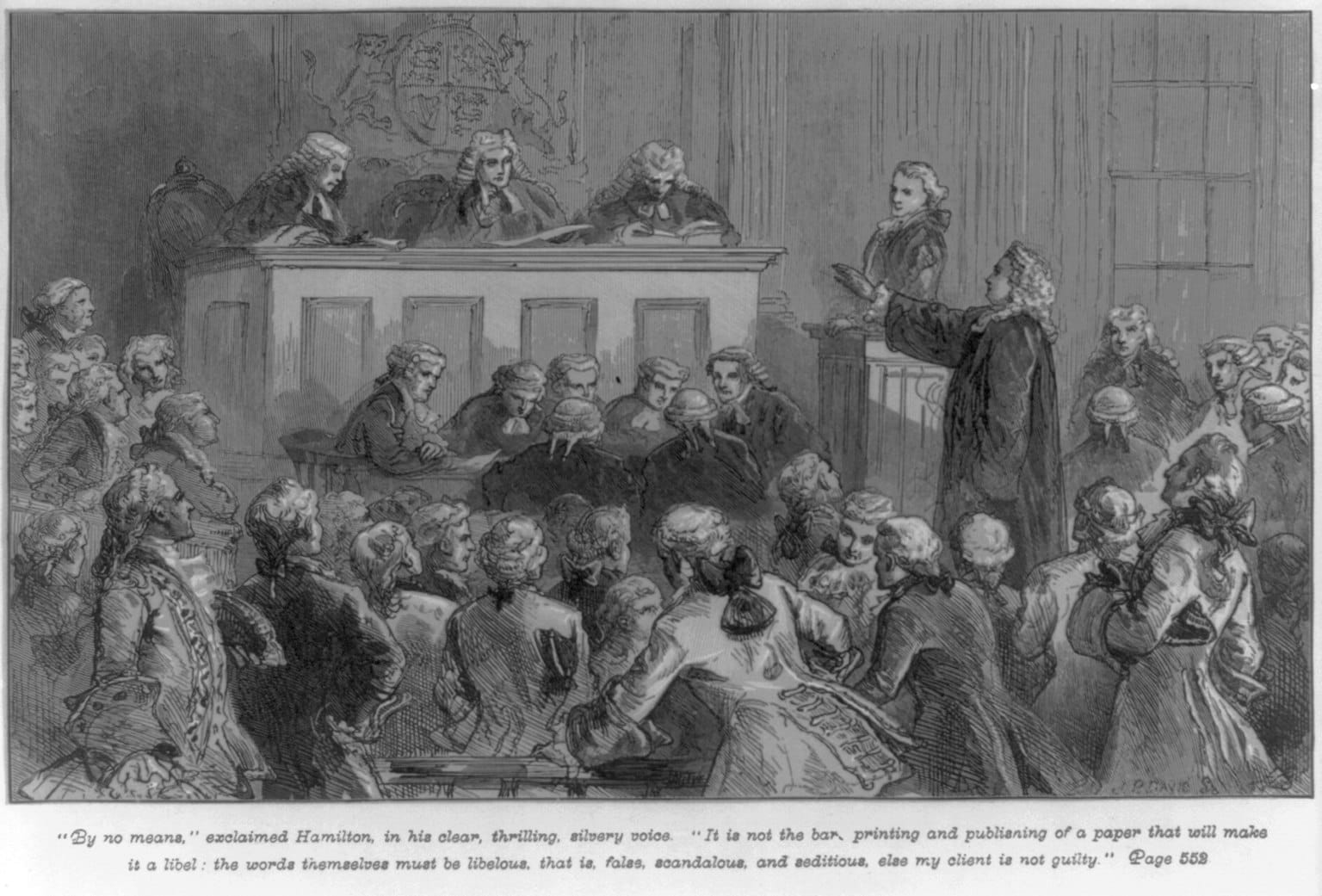
John Peter Zenger was a German immigrant printer who spent nearly nine months in jail for words he did not even write. His newspaper had been hammering the royal governor, and the governor wanted him punished for seditious libel. Under English law it was an easy case: it did not matter whether the criticism was true. Truth, the prosecutor argued, only made the libel worse. Then the Philadelphia lawyer Andrew Hamilton stood up and told the jury they could ignore the judge and the law and decide for themselves. They were out about ten minutes. The acquittal did not change a single statute for seventy years, but it lodged an idea in the colonial mind: that a free people cannot be jailed for telling the truth about power.
In their words
The event in the voices and documents of the people who were there. Every source links out so you can check it.
-
Testimony
Hamilton’s peroration, after the court had forbidden him from proving the printed criticisms true.
It is the best cause. It is the cause of liberty... every man who prefers freedom to a life of slavery will bless and honour you as men who have baffled the attempt of tyranny; and by an impartial and uncorrupt verdict, have laid a noble foundation for securing to ourselves, our posterity, and our neighbours, that to which nature and the laws of our country have given us a right, the liberty both of exposing and opposing arbitrary power by speaking and writing truth.
Andrew Hamilton, closing address to the jury, in James Alexander’s "Brief Narrative" (1736)
He was barred from arguing the truth in evidence, so he argued it to the jury’s conscience instead.
Source: Online Library of Liberty (Alexander’s 1736 narrative) -
Testimony
The Crown’s statement of the settled English law: under seditious libel, truth made the offense worse.
The law says that they are not the less libelous for that; nay indeed the law says, their being true is an aggravation of the crime.
Attorney General Richard Bradley, the prosecution, in Alexander’s "Brief Narrative" (1736)
This is the crux. On the law as it stood, Zenger was guilty. The jury had to defy it to acquit.
Source: Online Library of Liberty -
Document
A Cosby ally, DeLancey shut down every attempt by Hamilton to prove the criticisms accurate.
Chief Justice James DeLancey ruled from the bench that Zenger’s counsel could not give the truth of the printed statements in evidence, holding that the truth of a libel could not be admitted to justify it.
Chief Justice James DeLancey, in Alexander’s "Brief Narrative" (1736)
He had earlier disbarred James Alexander for challenging the court before trial.
Source: Historical Society of the New York Courts -
Testimony
The reaction in a packed City Hall the instant the foreman said "not guilty."
Upon which there were three huzza’s in the hall, which was crowded with people; and the next day I was discharged from my imprisonment.
Narrated in Zenger’s voice by James Alexander, "Brief Narrative" (1736); jury foreman Thomas Hunt returned the verdict
The pamphlet is written as if by Zenger, but its real author was his backer, the lawyer James Alexander.
Source: Famous Trials (UMKC) -
Document
The corrective view that separates the trial’s symbolic power from its negligible immediate legal effect.
The case is the groundwork of freedom of the press, not its legal precedent: succeeding royal governors continued to clamp down on the press until the Revolution, and the verdict did not change the law of seditious libel.
Modern historical assessment, First Amendment Encyclopedia
Truth did not become even a qualified defense in New York until 1805, seventy years later.
Source: First Amendment Encyclopedia (MTSU)
What people get wrong
-
The myth The verdict established freedom of the press in 1735.
What’s true It changed no law. Seditious-libel law was untouched, and royal governors kept jailing critics until the Revolution. Truth did not become even a qualified defense in New York until 1805.
-
The myth Zenger wrote the articles that jailed him.
What’s true He was the printer. The anti-Cosby pieces were written by his backers, chiefly the lawyer James Alexander. Zenger was jailed for printing them and never named his authors.
-
The myth It was a normal acquittal on the law.
What’s true It was jury nullification. The judge had ruled truth inadmissible, so on the law Zenger was guilty of printing. Hamilton persuaded the jury to ignore the instruction.
What it changed
- It became the founding text of American press freedom through Alexander’s 1736 "Brief Narrative," reprinted for decades in the colonies and London.
- It is a foundational jury-nullification case, still cited for the principle that a jury may judge the law as well as the facts.
- The real legal change came seventy years later: People v. Croswell (1804) led New York to make truth a qualified defense in 1805.
- Hamilton’s out-of-town brilliance is often credited as the origin of the phrase "a Philadelphia lawyer."
The New York Shelf
Read the whole story
Paid link. If you buy a book through this link, Bookshop.org pays us a small commission and sends a share of the sale to independent bookstores.
-
The history
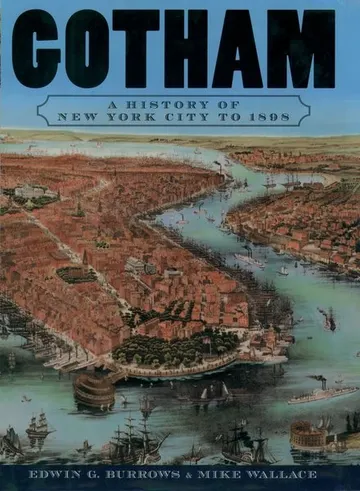
Gotham (opens Bookshop.org)
Edwin G. Burrows and Mike Wallace · 1999
Burrows and Wallace cover New York from its earliest settlement to consolidation in 1898, in a single volume of more than a thousand pages. It won the Pulitzer Prize for History.
The city is still writing this.
Four centuries end at this morning’s news. The daily brief picks up where the history leaves off: what changed in New York today and what it means, explained by breakfast.
Free. One email each morning. One-click unsubscribe. Never sold.