
to 1664
Lenapehoking & New Amsterdam
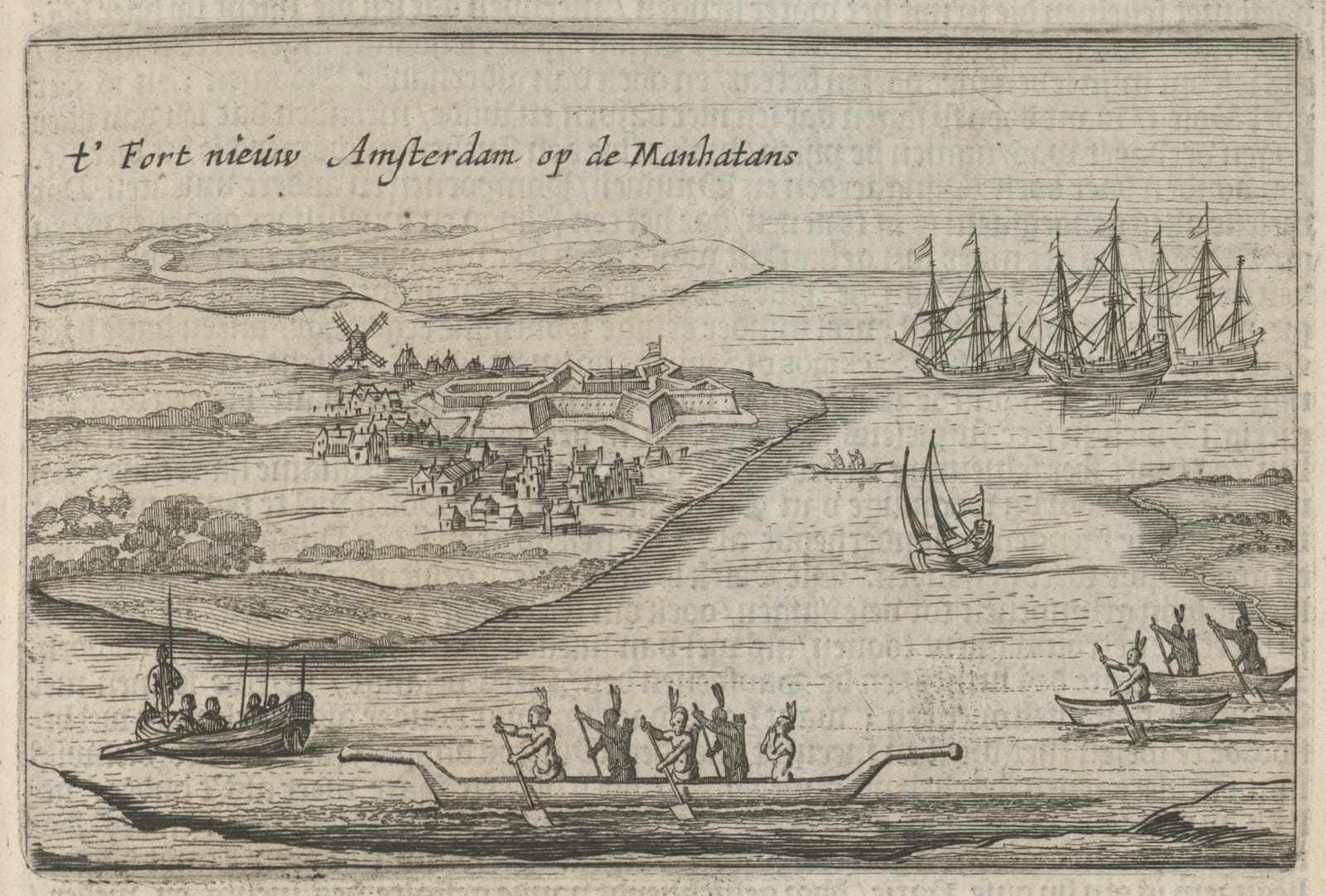
Before it was New York it was Lenapehoking, then a Dutch trading post at the tip of Manhattan. The record opens with a "purchase" that was nothing of the kind, a war on the people who were already here, and a tolerance the colony had to force on its own governor.
- 1609
September 15, 1609
Hudson Meets 'Loving People'
Sailing the river that would take his name, Hudson’s officer recorded both warm trade and violence with the river’s nations.
At night we came to other mountains, which lie from the river’s side. There we found very loving people, and very old men, where we were well used.
Robert Juet, officer aboard Henry Hudson’s Halve Maen (Half Moon), journal entry, September 15, 1609; first printed in Samuel Purchas, 'Hakluytus Posthumus' (1625)The same journal calls Native people "savages" days later, and the voyage ended in a deadly harbor skirmish. The record was never simple.
Source: New York State Archives / DEC, Juet’s Journal (transcription) - 1609
First written, 1609
'Manna-hata' Written Down
The Lenape gave the city its name long before the Dutch gave it a fort.
The island the Lenape called home first appears in writing as "Manna-hata" in Robert Juet’s 1609 journal of the Half Moon. The homeland itself was Lenapehoking, the land of the Lenni-Lenape.
Robert Juet’s 1609 journal (the place-name 'Manna-hata')
The popular gloss "place where we get bows" rests on a single 19th-century informant. The real meaning is genuinely uncertain, so be wary of anyone who tells you it’s settled.
Source: Etymology of Manhattan (sources collected) - 1626
November 5, 1626
The Schagen Letter: 60 Guilders
One sentence in a Dutch dispatch is the only contemporary record of the "purchase" of Manhattan.
They have purchased the Island of Manhattan from the Natives for the value of 60 guilders. It is about 22,000 acres in size.
Pieter Janszoon Schagen, reporting to the States General of the Netherlands on news off the ship Arms of Amsterdam, November 5, 1626The famous "$24 in beads and trinkets" is a myth. The letter says 60 guilders and never lists what was traded. And to the Lenape, land was shared use, not something you could sell away forever.
Source: Smithsonian / Nationaal Archief, The Hague (the Schaghen letter) Read the full story - 1643
February 1643
Eyewitness to the Pavonia Massacre
Director Willem Kieft ordered a night attack on Lenape families who had camped near the Dutch seeking protection, killing roughly 120 and igniting two years of war.
Infants were torn from their mothers’ breasts, and hacked to pieces in the presence of their parents, and the pieces thrown into the fire and in the water, and other sucklings being bound to small boards, were cut, stuck, and pierced, and miserably massacred in a manner to move a heart of stone.
David Pietersz de Vries, eyewitness, published in his journal (1655); he opposed the attack and watched from across the riverDe Vries argued against the slaughter and recorded it in horror. That a Dutch official is the witness is exactly why it is believed.
Source: Kieft’s War (de Vries’s published journal) Read the full story - 1644
February 25, 1644
Half-Freedom for Eleven Men
The first eleven Africans were brought to New Amsterdam around 1626; their petition won a constrained freedom and farmland north of the wall that became the city’s first free Black settlement.
The Council of New Netherland granted conditional "half-freedom" to eleven enslaved African men — among them Paulo d’Angola, Simon Congo, and Anthony Portuguese — who had served the Dutch West India Company some eighteen years, on the condition that they pay an annual tribute, and that their children remain bound to the Company.
Resolution of the Council of New Netherland, February 25, 1644
Their land grants sat in what is now Greenwich Village and Washington Square — the city’s first free Black neighborhood, two centuries before emancipation.
Source: NYPL / Land of the Blacks (council records) - 1653
March 13, 1653
A Wall Goes Up
With England and the Dutch Republic at war, New Amsterdam resolved to wall the little city’s landward side against an invasion from New England. The wooden palisade went up that spring.
Considering said Fort Amsterdam cannot hold all the inhabitants nor defend all the houses and dwellings in the City, it is deemed necessary to surround the greater part of the City with a high stockade and a small breastwork.
Resolution of Director-General Stuyvesant, his Council, and the city court of New Amsterdam, March 13, 1653The wall that named Wall Street was built against the English, not the Lenape. It came down in 1699; the street kept the name.
Source: NYC Municipal Archives ("For the Record") Read the full story - 1654
September 22, 1654
Stuyvesant Moves to Expel the Jews
Twenty-three Jews fleeing the Portuguese reconquest of Dutch Brazil reached New Amsterdam in 1654; Stuyvesant asked his employers for permission to throw them out.
We have... deemed it useful to require them in a friendly way to depart, praying also most seriously... that the deceitful race, — such hateful enemies and blasphemers of the name of Christ, — be not allowed to further infect and trouble this new colony.
Director-General Peter Stuyvesant, letter to the Amsterdam Chamber of the Dutch West India Company, September 22, 1654The Company overruled him and let them stay, partly because Jews were among its shareholders. New Amsterdam’s tolerance was real, but it had to be forced on its own governor.
Source: Jewish Women’s Archive / Gilder Lehrman - 1657
December 27, 1657
The Flushing Remonstrance
About thirty townsmen refused Stuyvesant’s order to bar Quakers, citing their charter’s promise of liberty of conscience.
The law of love, peace, and liberty in the states extending to Jews, Turks, and Egyptians, as they are considered the sons of Adam... condemns hatred, war, and bondage.
Residents of Flushing, Queens, petition to Stuyvesant protesting his ban on harboring Quakers, December 27, 1657Almost none of the signers were Quakers. They defended a faith they didn’t share, and several were jailed for it. It is often called a forerunner of the First Amendment.
Source: Flushing Remonstrance (NY State Archives) Read the full story - 1664
September 1664
The Bloodless Takeover
Outgunned by four English frigates and pressed by 93 citizens, including his own son, who begged him to give up, Stuyvesant surrendered without a shot. New Amsterdam became New York.
The Dutch here shall enjoy the liberty of their consciences in Divine Worship and church discipline.
Articles of Surrender of New Netherland, Article 8, agreed between Stuyvesant’s commissioners and Colonel Richard Nicolls, 1664The defiant line "I would rather be carried to my grave than surrender" is a later legend with no contemporary record. What survives is the signed surrender, and the petition begging him to sign it.
Source: Articles of Surrender of New Netherland Read the full story - 1679
October 6, 1679
A Visitor Walks the Free Black Farms
A Dutch visitor described the farms of formerly enslaved New Amsterdammers fifteen years after the English took over the colony.
We went from the city, following the Broadway, over the valley, or the fresh water. Upon both sides of this way were many habitations of negroes, mulattoes and whites. These negroes were formerly the proper slaves of the (West India) company, but, in consequence of the frequent changes and conquests of the country, they have obtained their freedom and settled themselves down where they have thought proper, and thus on this road, where they have ground enough to live on with their families.
Jasper Danckaerts, journal entry, October 6, 1679The half-freedom these families won from the Dutch West India Company in 1644 outlasted Dutch rule itself, at least for the families still holding their land.
Source: Journal of Jasper Danckaerts, 1679-1680, ed. James and Jameson, trans. Henry C. Murphy (1913), p. 65 Read the full story
The New York Shelf
The book on this era
Paid links. If you buy a book through these links, Bookshop.org pays us a small commission and sends a share of the sale to independent bookstores.
-
The history
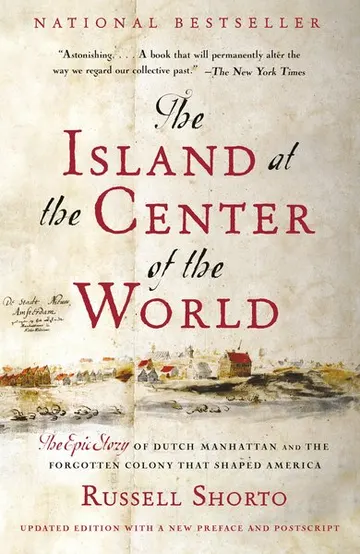
The Island at the Center of the World (opens Bookshop.org)
Russell Shorto · 2004
Shorto draws on the translated Dutch colonial records to reconstruct New Amsterdam under Peter Stuyvesant, and argues that its tolerant, commercial culture shaped the country.
-
The history
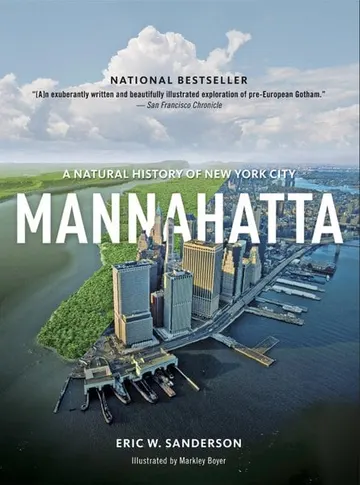
Mannahatta (opens Bookshop.org)
Eric W. Sanderson · 2009
Sanderson and the Wildlife Conservation Society's Mannahatta Project rebuild the island Henry Hudson saw in 1609, with its streams, forests, wetlands and animals, and lay them over today's streets.
-
The history
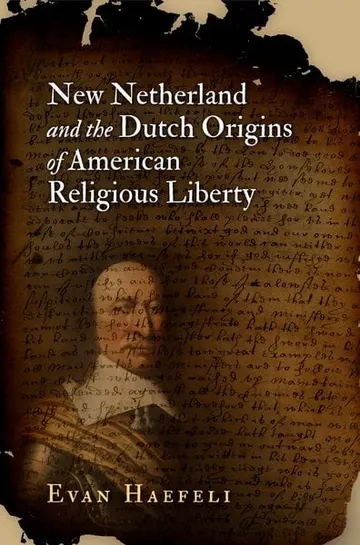
New Netherland and the Dutch Origins of American Religious Liberty (opens Bookshop.org)
Evan Haefeli · 2012
Haefeli examines how the Dutch colony handled Quakers, Jews and Lutherans, including the 1657 Flushing Remonstrance, and how that record fed later ideas of religious freedom.
-
The history
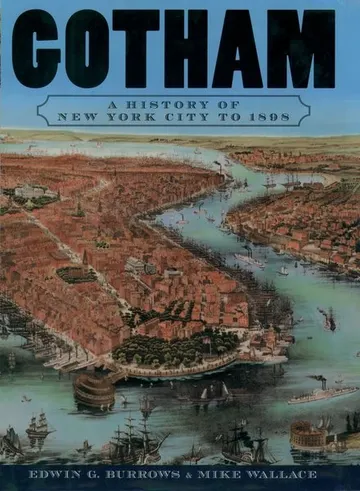
Gotham (opens Bookshop.org)
Edwin G. Burrows and Mike Wallace · 1999
Burrows and Wallace cover New York from its earliest settlement to consolidation in 1898, in a single volume of more than a thousand pages. It won the Pulitzer Prize for History.
The city is still writing this.
Four centuries end at this morning’s news. The daily brief picks up where the history leaves off: what changed in New York today and what it means, explained by breakfast.
Free. One email each morning. One-click unsubscribe. Never sold.