
The Colonial City & the Revolution · August 27, 1776
The Battle of Brooklyn
The biggest battle of the entire Revolution was fought across Brooklyn seven weeks after independence was declared. Washington lost it in a morning, and then pulled off the escape that saved the war.
The facts
- The date
- August 27, 1776; the escape came on the night of August 29–30
- The scale
- The largest battle of the Revolutionary War in troops deployed and engaged: some 32,000 British and Hessian troops had massed on Staten Island against roughly 10,000 Americans on Long Island
- The flank
- A 10,000-man British column marched all night through the unguarded Jamaica Pass; the five American militia officers watching it were captured without a shot
- The cost
- About 300 Americans killed and over 1,000 captured, Generals Sullivan and Stirling among them; the British and Hessians reported about 65 killed
- The stand
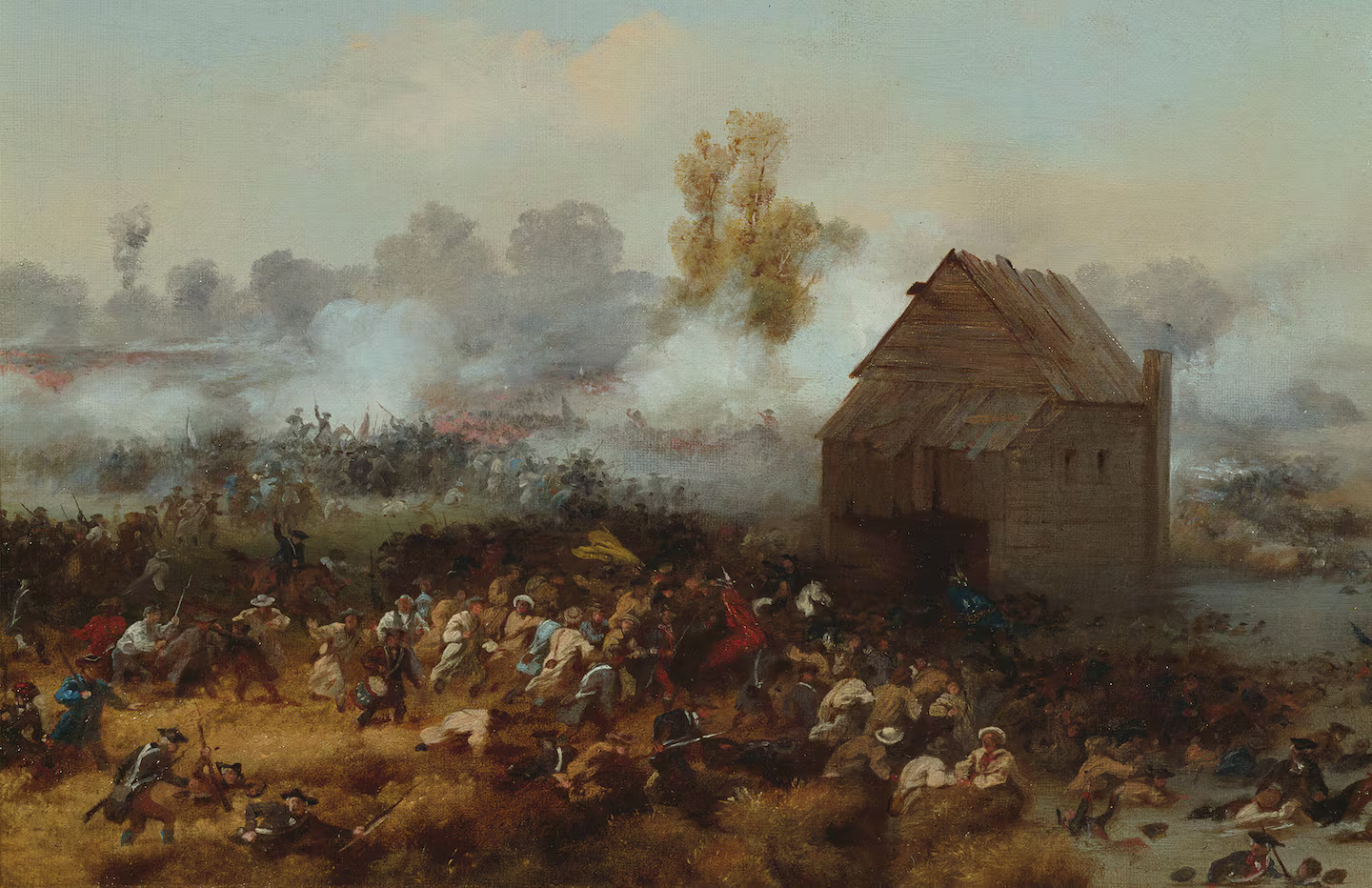
- Roughly 400 Marylanders and Delawareans counterattacked at the Old Stone House to cover the retreat; 256 were killed
- The escape
- All 9,000 troops were rowed across the East River to Manhattan in one night, without the loss of a single life
Seven weeks after the Declaration of Independence was read to Washington’s army in New York, the British came to take the city back. What followed on August 27, 1776 was the largest battle of the whole war, and the Americans lost it in a morning. While British and Hessian columns pressed the passes through the wooded ridge of Guan Heights, a third column of 10,000 men had marched all night through the one pass nobody guarded, at Jamaica, and appeared behind the American line. The army collapsed back toward Brooklyn Heights. What kept the defeat from ending the Revolution was a rear guard of about 400 Marylanders and Delawareans who charged the British position at a stone farmhouse again and again while the rest escaped through the marsh, and a silent one-night evacuation in which Massachusetts sailors and fishermen rowed all 9,000 survivors across the East River. The fog at dawn kept the secret. The British woke to empty lines.
In their words
The event in the voices and documents of the people who were there. Every source links out so you can check it.
-
Memoir
The evacuation ran all night; at daybreak part of the army was still in the lines. Then the fog settled.
At this time a very dense fog began to rise, and it seemed to settle in a peculiar manner over both encampments. I recollect this peculiar providential occurrence perfectly well; and so very dense was the atmosphere that I could scarcely discern a man at six yards’ distance.
Benjamin Tallmadge, who crossed with the rear guard on the morning of August 30, 1776 ("Memoir," 1858)
Tallmadge also recorded the battle’s private cost: "I also lost a brother the same day, who fell into their hands, and was afterwards literally starved to death in one of their prisons." The prison ships have their own page in this era.
Source: Memoir of Col. Benjamin Tallmadge (Internet Archive) -
Letter
"His Lordship" is Gen. William Alexander, Lord Stirling, who led the Marylanders’ counterattacks and then surrendered himself to the Hessians rather than to the British.
Being thus surrounded, and no probability of a reinforcement, his Lordship ordered me to retreat.
Maj. Mordecai Gist of the Maryland battalion, letter of August 30, 1776, on the stand at the Old Stone House
Of about 400 men in the rear guard, 256 were killed and over 100 captured; a few dozen got back to the American lines, some through the marsh and millponds.
Source: Finding the Maryland 400 (Maryland State Archives) -
Testimony
A survivor’s own spelling of the men who closed in on him: Scottish Highlanders and hired Hessians.
We were surrounded by Healanders on one side, Hessians on the other.
Pvt. William McMillan of the Maryland 400, pension application, 1828 ("Healanders": Highlanders)
McMillan again: "My captain was killed, first lieutenant was killed, second lieutenant shot through the hand." The fight at the house lasted about an hour.
Source: Finding the Maryland 400 (Maryland State Archives) -
Speech
The most famous words of the day, said to have escaped Washington as he watched the rear guard charge the British guns.
Good God! What brave fellows I must this day lose!
George Washington, watching the Maryland counterattacks from the Brooklyn defenses, as traditionally reported
Treat the wording as tradition, not transcript: it is "reported," with no contemporary record, like most battlefield exclamations. The 256 dead Marylanders are documented fact.
Source: American Battlefield Trust -
Document
The defeat was total; the extraction was perfect.
On the night of August 29–30, John Glover’s Massachusetts regiment of sailors and fishermen rowed the army across the East River to Manhattan. By morning, all 9,000 troops had been evacuated with no loss of life.
The evacuation of Long Island, August 29–30, 1776 (sources collected)
Tallmadge, stepping into one of the last boats: "I think I saw Gen. Washington on the ferry stairs when I stepped into one of the last boats that received the troops."
Source: Battle of Long Island (sources collected)
What people get wrong
-
The myth The "Maryland 400" died to the last man.
What’s true About 400 made the stand; 256 were killed, more than 100 were captured, and a few dozen escaped. More than 800 Marylanders fought that day in Smallwood’s battalion. The round number and the total sacrifice are both tradition; the documented losses are terrible enough.
-
The myth A miraculous fog hid the whole escape.
What’s true The crossing ran through the night on darkness, silence, and the seamanship of Glover’s Massachusetts men. The famous fog arrived near daybreak and covered the last boats, Tallmadge’s among them. It finished the escape; it did not make it.
-
The myth The battle was fought out on today’s suburban Long Island.
What’s true It was fought in what is now Brooklyn. The Old Stone House the Marylanders charged stands today at a playground in Park Slope. The period name "Battle of Long Island" confuses modern ears because Brooklyn sits at the island’s western end.
What it changed
- The first major battle after the Declaration of Independence was a British victory, but the army survived it; the British took New York on September 15 and held the city for the rest of the war, until Evacuation Day, 1783.
- The more than 1,000 Americans captured fed the British prison system and then the prison ships of Wallabout Bay, where more Americans likely died than in all the war’s battles.
- The Old Stone House, rebuilt from its original stones in 1934, stands in J. J. Byrne Playground at Washington Park in Park Slope, and the Maryland flag flies from it for the men who charged it.
- The evacuation set the pattern that won the war: lose the field if you must, save the army, and make the war too long and too expensive to win.
The New York Shelf
Read the whole story
Paid links. If you buy a book through these links, Bookshop.org pays us a small commission and sends a share of the sale to independent bookstores.
-
The history
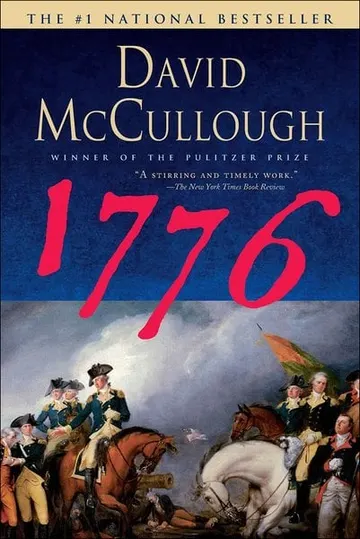
1776 (opens Bookshop.org)
David McCullough · 2005
McCullough tracks the year of the Declaration from the Siege of Boston through the Battle of Brooklyn and Washington's retreat across New York and New Jersey, with letters and diaries from both armies.
-
The history
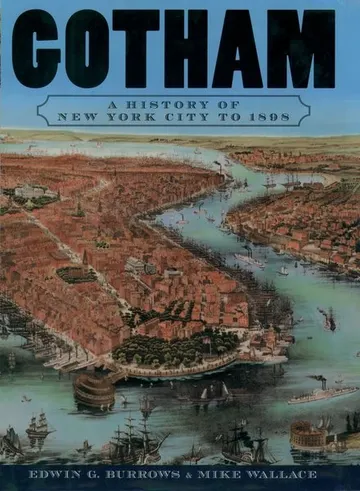
Gotham (opens Bookshop.org)
Edwin G. Burrows and Mike Wallace · 1999
Burrows and Wallace cover New York from its earliest settlement to consolidation in 1898, in a single volume of more than a thousand pages. It won the Pulitzer Prize for History.
The city is still writing this.
Four centuries end at this morning’s news. The daily brief picks up where the history leaves off: what changed in New York today and what it means, explained by breakfast.
Free. One email each morning. One-click unsubscribe. Never sold.