
War, Machine & Bridge · Dedicated October 28, 1886
The Statue of Liberty
It was a French gift about the end of slavery, not immigration. The famous poem was not added for seventeen more years, and a tabloid crowdfunded the pedestal.
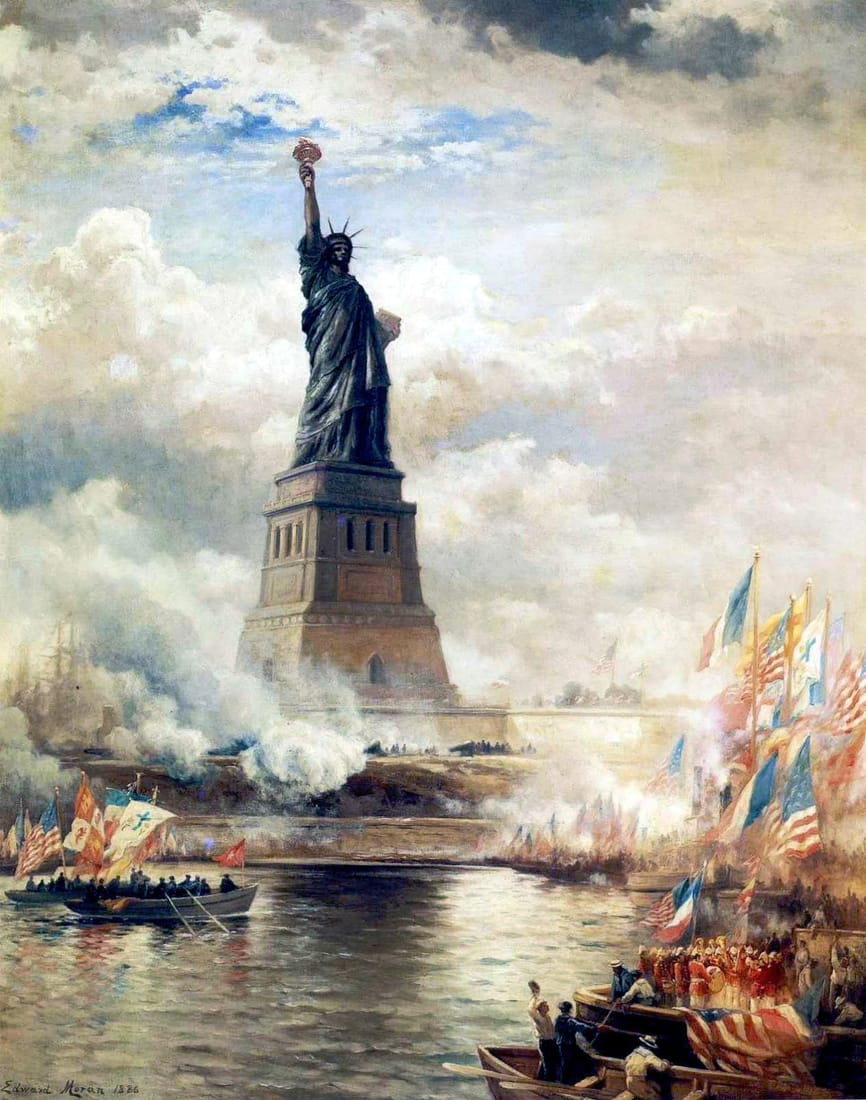
The facts
- When
- Dedicated in New York Harbor on October 28, 1886; arrived from France in June 1885 in 214 crates
- Formal name
- "Liberty Enlightening the World"
- The makers
- Sculptor Frédéric-Auguste Bartholdi; the iron skeleton by Gustave Eiffel; pedestal by Richard Morris Hunt
- The idea
- From French abolitionist Édouard de Laboulaye; a broken shackle and chain lie at her feet
- Scale
- 151 feet from heel to torch, on a 154-foot pedestal; 377 steps to the crown
- The pedestal
- Funded by Joseph Pulitzer’s 1885 New York World campaign, about 125,000 donors, most giving under a dollar
Most of what the Statue of Liberty means now, it did not mean at the start. It was a gift from France, dreamed up by an abolitionist to mark the end of slavery, with a broken shackle and chain at her feet that almost nobody looks at. It was not about immigration. Emma Lazarus’s sonnet, the "give me your tired, your poor" that defines the statue today, was written in 1883 to raise money and then nearly forgotten; it was not mounted on the pedestal until 1903, sixteen years after Lazarus died. France paid for the statue, but the money for the pedestal ran out, and it was a tabloid crusade, Joseph Pulitzer’s New York World shaming the rich and printing every small donor’s name, that finally raised it, from 125,000 ordinary people.
In their words
The event in the voices and documents of the people who were there. Every source links out so you can check it.
-
Song
Written to raise pedestal funds, the sonnet recast the statue as the "Mother of Exiles."
Keep, ancient lands, your storied pomp!
cries she
With silent lips. Give me your tired, your poor,
Your huddled masses yearning to breathe free,
The wretched refuse of your teeming shore.
Send these, the homeless, tempest-tost to me,
I lift my lamp beside the golden door!
Emma Lazarus, "The New Colossus," written November 1883
It played no role at the 1886 dedication. It was mounted on a plaque inside the pedestal in 1903.
Source: Academy of American Poets -
Newspaper
Pulitzer launched the pedestal drive after the funds ran out, promising to print every donor’s name.
Let us not wait for the millionaires to give us this money. It is not a gift from the millionaires of France to the millionaires of America, but a gift of the whole people of France to the whole people of America.
Joseph Pulitzer, editorial in the New York World, March 16, 1885
About 125,000 people gave more than $100,000, most in gifts of a dollar or less. It is a founding example of crowdfunding.
Source: National Park Service -
Document
Laboulaye, who conceived the gift, was a cofounder of the French Anti-Slavery Society.
A broken shackle and chain lie at the Statue’s right foot. The chain disappears beneath the draperies, only to reappear in front of her left foot, its end link broken.
National Park Service, on the statue’s abolition origins
Bartholdi’s early model had Liberty holding broken chains aloft; he moved them to her feet, half-hidden, in an era when American backers were uneasy with overt anti-slavery symbolism.
Source: National Park Service, Statue of Liberty National Monument -
Speech
Cleveland accepted the statue, playing on its formal name, "Liberty Enlightening the World."
A stream of light shall pierce the darkness of ignorance and man’s oppression, until liberty enlightens the world.
President Grover Cleveland, dedication remarks, October 28, 1886
Women were barred from the island ceremony; suffragists chartered a boat to protest a female Liberty unveiled where women could not vote.
Source: The American Presidency Project
What people get wrong
-
The myth "The New Colossus" was part of the 1886 dedication.
What’s true It was written in 1883 for a fundraiser, largely forgotten, and played no role at the opening. It was mounted on a plaque inside the pedestal in 1903.
-
The myth The statue was always about immigration.
What’s true Its conception was about Franco-American friendship, liberty, and the abolition of slavery. The immigration meaning grew later, with Ellis Island and the 1903 Lazarus plaque.
-
The myth The broken chains are just decoration.
What’s true They mark the end of slavery after the Civil War. Bartholdi moved them from her hand to her feet, half-hidden, in an era when American backers were uneasy with overt anti-slavery symbolism.
What it changed
- Pulitzer’s 1885 campaign, 125,000 donors mostly giving under a dollar, is a foundational example of crowdfunding.
- Lazarus’s words, added in 1903, made the statue synonymous with the American immigrant ideal, a meaning absent at its dedication.
- Eiffel’s internal iron skeleton was a proving ground for the tower he built three years later.
- A U.S. National Monument since 1924 and a UNESCO World Heritage Site since 1984.
The New York Shelf
Read the whole story
Paid link. If you buy a book through this link, Bookshop.org pays us a small commission and sends a share of the sale to independent bookstores.
-
The history
The Statue of Liberty (opens Bookshop.org)
Edward Berenson · 2012
Berenson traces how a French idea about liberty became the statue in New York Harbor, and how its meaning shifted for immigrants and Americans.
The city is still writing this.
Four centuries end at this morning’s news. The daily brief picks up where the history leaves off: what changed in New York today and what it means, explained by breakfast.
Free. One email each morning. One-click unsubscribe. Never sold.