
War, Machine & Bridge · Opened May 24, 1883
The Brooklyn Bridge
It took fourteen years, around twenty-seven lives, and three Roeblings to throw a steel road across the East River. The one who finished it was a woman nobody would let be an engineer.
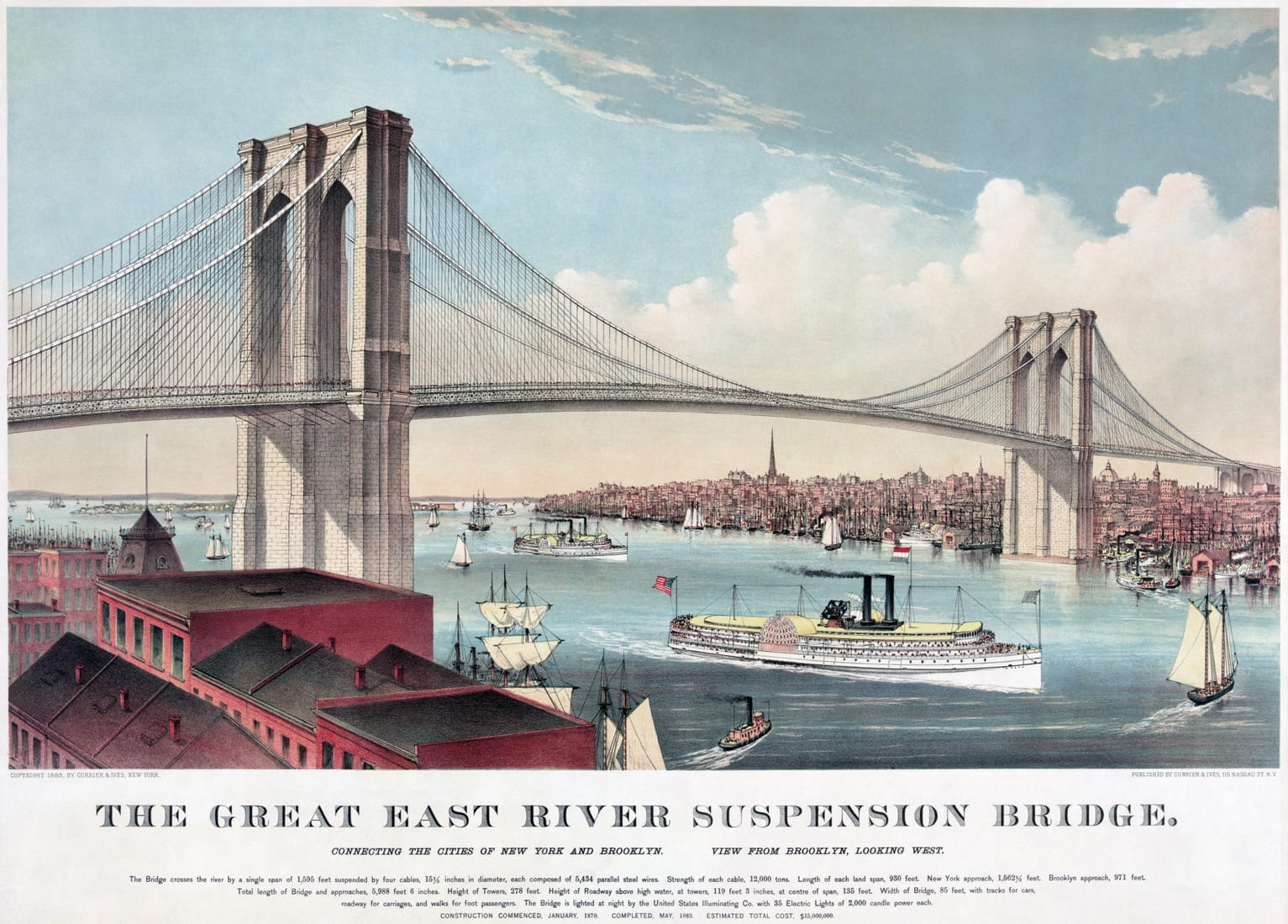
The facts
- Built
- January 1870 to May 24, 1883, about fourteen years
- Scale
- A 1,595-foot main span, the longest suspension span in the world at its opening, on towers 278 feet above the water
- Cost
- About $15 million; Brooklyn paid two-thirds
- Deaths in construction
- Disputed: commonly cited as about 27, though David McCullough counts 21. The honest range is roughly 20 to 27
- Opening day
- 150,300 people and 1,800 vehicles crossed
- Six days later
- A false rumor of collapse triggered a stairway stampede that killed 12
It took fourteen years, around twenty-seven lives, and three Roeblings to throw a road across the East River. John Roebling designed it and died before a stone was laid, his foot crushed by a ferry. His son Washington took over and was crippled by the bends, the caisson disease workers got digging the foundations down to bedrock under compressed air. So Washington’s wife, Emily Warren Roebling, taught herself engineering and effectively ran the largest construction project in the country from his sickroom for over a decade. When it opened in 1883 it was the longest suspension span on earth, and the first built of steel wire. Six days later a rumor that it was collapsing killed twelve people in a stampede on the stairs. The next year, P. T. Barnum marched twenty-one elephants across to prove it would hold.
In their words
The event in the voices and documents of the people who were there. Every source links out so you can check it.
-
Speech
On opening day, the official oration publicly named a woman as essential to the engineering. In 1883, that was extraordinary.
The name of Mrs. Emily Warren Roebling will thus be inseparably associated with all that is admirable in human nature, and with all that is wonderful in the constructive world of art... an everlasting monument to the self-sacrificing devotion of woman, and of her capacity for that higher education from which she has been too long debarred.
Congressman Abram S. Hewitt, opening-ceremony oration, May 24, 1883
Emily Roebling was the first person to cross the finished bridge.
Source: Gotham Oratory Archive (the 1883 official program) -
Document
For roughly a decade she was the bridge’s effective on-site engineer and its public face.
Emily Warren Roebling relayed information from her husband to his assistants and reported back the progress of the work, taking over much of the chief engineer’s duties, including day-to-day supervision and project management.
The biographical record of Emily Warren Roebling
She studied higher mathematics, materials, and cable construction so she could carry her bedridden husband’s instructions to the site and judge whether they were being followed.
Source: Emily Warren Roebling (collected sources) -
Document
The chief engineer of the world’s largest bridge never returned to the site full-time after the bends crippled him.
After caisson disease paralyzed him in 1872, chief engineer Washington Roebling directed the work for years by watching the site through a telescope from his sickroom on Columbia Heights and sending written instructions out by his wife.
The engineering record of Washington A. Roebling
He ran it from a window for over a decade, which is exactly why his wife became indispensable.
Source: American Society of Civil Engineers -
Newspaper
Six days after the opening, a woman fell on the stairway, someone screamed, and a rumor spread that the bridge was collapsing.
In a moment the whole stairway was packed with dead and dying men, women and children piled upon another in a writhing, struggling mass.
The New York Times, on the May 30, 1883 stampede
Twelve people were crushed to death. Nothing had actually failed; the bridge was sound.
Source: The Brooklyn Bridge stampede (NYT account) -
Newspaper
A year after the stampede, P. T. Barnum walked 21 elephants and 17 camels across to reassure a jittery public, and to publicize his circus.
England’s pet, old Jumbo, his Royal Sacredness, the white elephant, and the mighty name of Barnum added a new lustre to the bridge last night.
The New York Times, reporting Barnum’s procession, May 18, 1884
It was as much a Barnum stunt as a safety test, and the bridge company was happy to have it.
Source: HISTORY (quoting the New York Times)
What people get wrong
-
The myth John Roebling built the Brooklyn Bridge.
What’s true He designed it and died in 1869, before construction began. Three Roeblings built it: John designed it, his son Washington was chief engineer, and Washington’s wife Emily ran the site for over a decade after the bends crippled him.
-
The myth Emily Roebling crossed first carrying a rooster for luck.
What’s true A cherished story, but it traces to a David McCullough book, not to any 1883 source. She did make the first crossing; the rooster is a well-loved anecdote, not documented fact.
-
The myth About 27 people died building it.
What’s true That is the most-cited figure, from an assistant engineer’s tally, but it is not settled. McCullough counts 21. The honest answer is a range of roughly 20 to 27.
What it changed
- At 1,595 feet, its main span was the longest of any suspension bridge in the world, a record it held for twenty years.
- It was the first suspension bridge built with steel-wire cables, proving steel at monumental scale.
- It physically tied Brooklyn to Manhattan, accelerating the 1898 consolidation of the five boroughs into one city.
- A National Historic Landmark since 1964, it still carries traffic and walkers about 140 years on, with a plaque honoring all three Roeblings.
The New York Shelf
Read the whole story
Paid link. If you buy a book through this link, Bookshop.org pays us a small commission and sends a share of the sale to independent bookstores.
-
The history
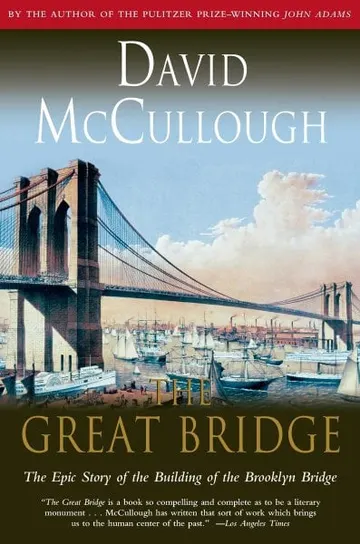
The Great Bridge (opens Bookshop.org)
David McCullough · 1972
John Roebling, Washington Roebling and Emily Roebling built the Brooklyn Bridge between 1869 and 1883. McCullough tells it, including the caisson disease that disabled Washington.
The city is still writing this.
Four centuries end at this morning’s news. The daily brief picks up where the history leaves off: what changed in New York today and what it means, explained by breakfast.
Free. One email each morning. One-click unsubscribe. Never sold.