
The Empire City Rises · The 19th century
The Five Points
The slum the world used as shorthand for urban poverty, built on a buried pond. It was also one of America’s first integrated neighborhoods, and a birthplace of tap.

The facts
- Where
- Lower Manhattan, where Anthony, Orange, and Cross Streets met (now Worth, Baxter, and Mosco, by Columbus Park)
- Built on
- The filled-in Collect Pond, drained by 1811; the bad landfill sank and festered
- Who
- Mostly Irish, especially after the 1840s Famine, alongside a large free Black community
- The reputation
- The most notorious slum in the Western world, rivaled only by parts of London
- The Old Brewery
- A single tenement so infamous a missionary society bought and tore it down in 1852
- The end
- The worst block, Mulberry Bend, was razed by 1895; Columbus Park opened on the ground in 1897
The Five Points was the slum every 19th-century writer reached for when they wanted to describe the bottom. It sat on the filled-in Collect Pond, a former freshwater source so fouled by tanneries that the city drained it; the landfill was botched, the ground sank, and the poor moved into what the middle class fled. What the horror stories leave out is that it was a real neighborhood, mostly Irish and free Black, living closer together than almost anywhere else in America. The same dance halls that scandalized Charles Dickens in 1842 were where Irish jigs met African rhythm and produced what became tap. Davy Crockett, a decade earlier, was unsettled less by the squalor than by the sight of "black and white, white and black, all hug-em-snug together." The Bend, its worst stretch, came down after Jacob Riis photographed it, and a park stands there now.
In their words
The event in the voices and documents of the people who were there. Every source links out so you can check it.
-
Memoir
Dickens toured the Five Points led by police on his 1842 American trip. His chapter made the slum world-famous.
This is the place: these narrow ways, diverging to the right and left, and reeking everywhere with dirt and filth.
Charles Dickens, American Notes for General Circulation, 1842
Source: Project Gutenberg (full text, public domain) -
Memoir
Dickens did not name the dancer, later identified as William Henry Lane, "Master Juba," a free Black performer whose Irish-African fusion is a root of American tap.
Single shuffle, double shuffle, cut and cross-cut; snapping his fingers, rolling his eyes, turning in his knees, presenting the backs of his legs in front, spinning about on his toes and heels like nothing but the man’s fingers on the tambourine.
Charles Dickens, American Notes, 1842, on a dancer at a Five Points hall
The Juba identification came later, from his 1848 London tour billing. Dickens called him only "the greatest dancer known."
Source: Project Gutenberg -
Memoir
The book published under Davy Crockett’s name recorded a racially mixed dance cellar in the Five Points, a decade before Dickens.
Black and white, white and black, all hug-em-snug together, happy as lords and ladies, sitting sometimes round in a ring, with a jug of liquor between them.
An Account of Col. Crockett’s Tour to the North and Down East, 1835
The book was ghostwritten, so read it as the "Crockett" persona. The original spelling reads "fidling" and "sitting sometimes round in a ring."
Source: Internet Archive (the 1835 edition) -
Document
Riis’s photographs and prose drove the demolition of Mulberry Bend, the worst block of the old Five Points.
Where Mulberry Street crooks like an elbow within hail of the old depravity of the Five Points, is "the Bend," foul core of New York’s slums.
Jacob A. Riis, How the Other Half Lives, 1890
Source: Project Gutenberg -
Inscription
The Old Brewery, a single tenement, was so infamous that a Methodist missionary society bought and demolished it in December 1852.
The Old Brewery at the Five Points, N.Y., as it appeared Dec.r 1st 1852, previous to its being torn down by the Ladies Home Missionary Soc.y of the M.E. Church.
Caption of an 1852 lithograph by Charles Parsons
Its legend of "a murder a night" comes from Herbert Asbury’s sensational 1928 Gangs of New York, not the record. The 1850 census counted about 221 people in it.
Source: The Metropolitan Museum of Art -
Document
The standard modern history, built on census records, reframed the slum as a working community, not only a den of vice.
The Five Points had more fighting, drinking, and vice than almost anywhere else; but also more dancing and nightlife, more dense networks of clubs and charities, and opportunities both small and large for those who seized them.
Tyler Anbinder, Five Points, 2001
Source: Tyler Anbinder, Five Points (Free Press, 2001)
What people get wrong
-
The myth The Five Points was nothing but a den of crime and vice.
What’s true It was a real, mostly Irish and free Black working neighborhood, with churches, charities, jobs, and families. Census-based history documents survival and upward mobility, not only squalor.
-
The myth The "Gangs of New York" version is roughly accurate.
What’s true The gangs were real, but the neighborhood’s defining story is immigrant settlement and one of America’s earliest examples of Black and white New Yorkers living side by side, not endless gang war.
-
The myth The Old Brewery saw a murder every night.
What’s true That figure, and the bones-in-the-walls lore, come from Herbert Asbury’s 1928 pulp history. The 1850 census found about 221 people in the building. It was overcrowded and poor, not a nightly slaughterhouse.
What it changed
- The Irish step and African juba danced in its halls, embodied by Master Juba, are credited by dance historians as a foundation of American tap.
- Columbus Park still occupies the cleared Mulberry Bend, the city’s tangible inheritance from the slum-clearance movement.
- Jacob Riis’s photographs of the Bend became a template for documentary reform photography and helped launch housing reform.
- The Five Points is repeatedly cited as one of the first large-scale instances of Black and white working-class New Yorkers living together.
The New York Shelf
Read the whole story
Paid links. If you buy a book through these links, Bookshop.org pays us a small commission and sends a share of the sale to independent bookstores.
-
The history
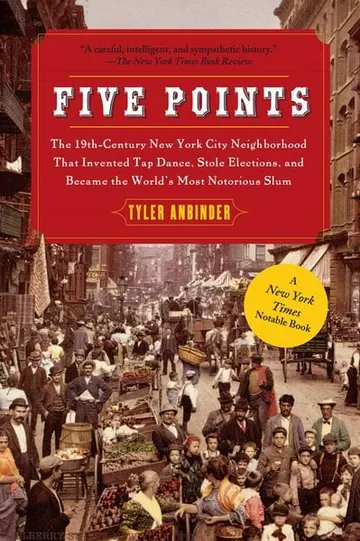
Five Points (opens Bookshop.org)
Tyler Anbinder · 2001
Anbinder reconstructs the Lower Manhattan neighborhood from census, tax and police records, and sorts its documented history from the legends.
-
The history
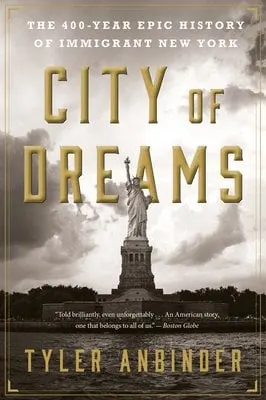
City of Dreams (opens Bookshop.org)
Tyler Anbinder · 2016
Each wave of arrivals, from the Dutch to recent immigrants, and how they found work, housing and political voice in the city. Anbinder organizes it by group.
-
The history
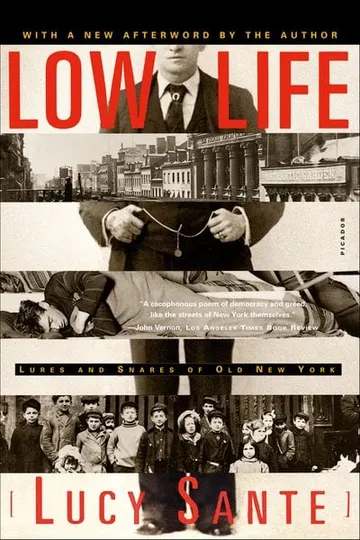
Low Life (opens Bookshop.org)
Luc Sante · 1991
Sante describes the city's underworld from the 1840s to the 1920s: the saloons, brothels, gangs and gambling dens, and the reformers and journalists who wrote about them.
The city is still writing this.
Four centuries end at this morning’s news. The daily brief picks up where the history leaves off: what changed in New York today and what it means, explained by breakfast.
Free. One email each morning. One-click unsubscribe. Never sold.