
The Empire City Rises · Opened October 14, 1842
The Croton Aqueduct
Before it, New York drank from foul wells and watched fires burn for want of water. The Croton Aqueduct brought clean water 41 miles by gravity, and the city threw a party.
The facts
- The problem
- Foul wells, a polluted pond, cholera epidemics, and fires the city could not fight
- The vote
- New Yorkers approved the aqueduct by referendum in 1835, 17,330 to 5,963
- The build
- 1837 to 1842, a 41-mile gravity-fed masonry conduit from the Croton River in Westchester
- The engineer
- John B. Jervis, who set the grade and designed the High Bridge over the Harlem River
- The reservoir
- A distributing reservoir at 42nd Street, on the site of today’s New York Public Library
- The opening
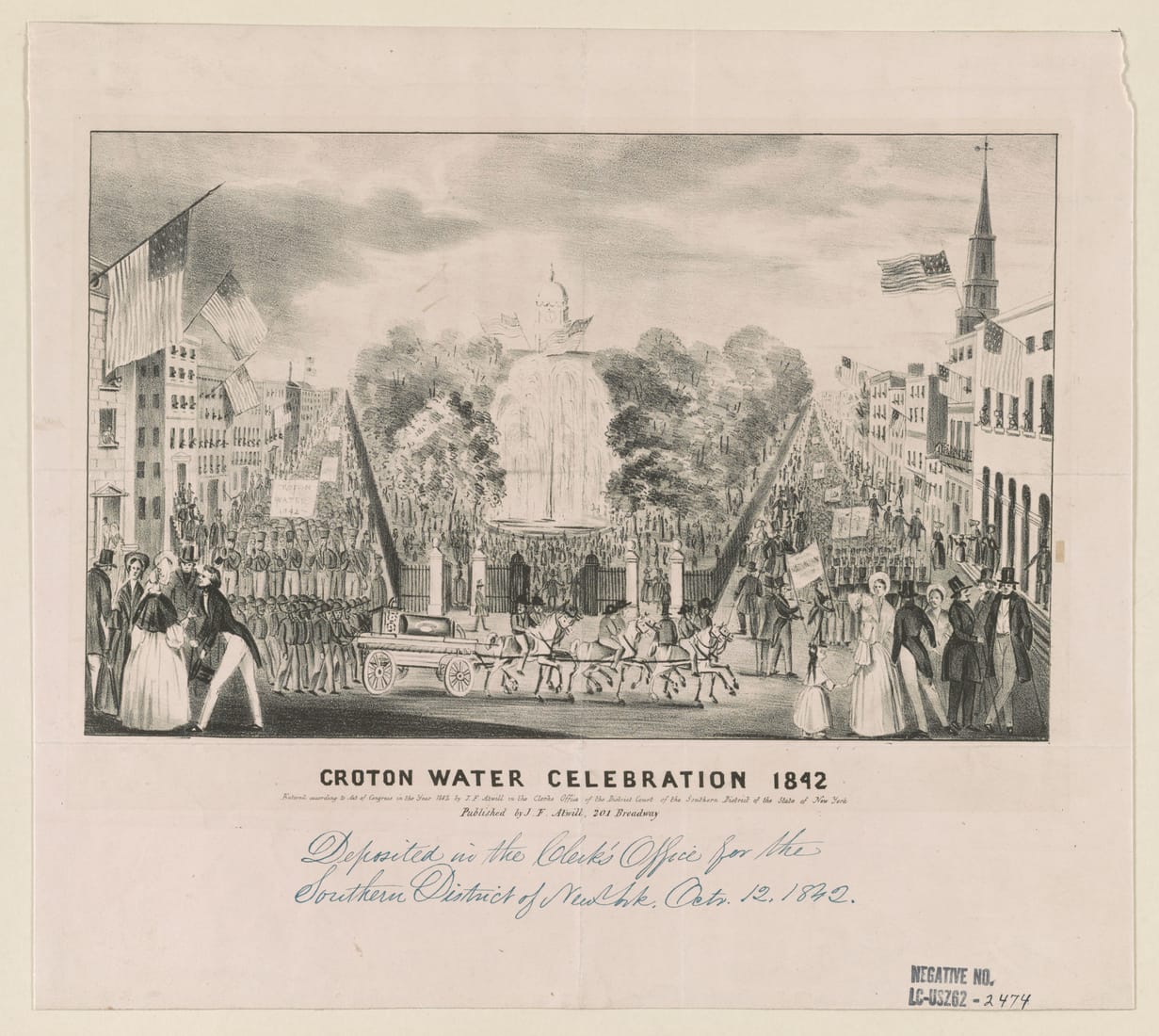
- A seven-mile parade on October 14, 1842, and fountains leaping in City Hall Park
For two centuries New York drank bad water. The wells were foul, the Collect Pond was a sink of filth, cholera came back again and again, and when the Great Fire of 1835 destroyed much of lower Manhattan, the water was frozen and scarce and the city could only watch it burn. So New Yorkers voted, in 1835, to build something enormous: a 41-mile masonry aqueduct to carry clean water by gravity from a dammed river in Westchester, across the Harlem on the High Bridge, into reservoirs in Manhattan. The chief engineer, John B. Jervis, set the slope at thirteen inches to the mile so the water would flow the whole way on its own. When Croton water arrived in 1842, the city threw one of the largest celebrations in its history: a seven-mile parade, fountains shooting fifty feet into the air, and a song written for the day. Clean water did more to save New York lives than any doctor of the age.
In their words
The event in the voices and documents of the people who were there. Every source links out so you can check it.
-
Song
The official song of the day named the two enemies clean water had beaten: disease and fire.
Water leaps as if delighted,
While her conquered foes retire!
Pale Contagion flies affrighted
With the baffled demon Fire!
George Pope Morris, "The Croton Ode," sung at the celebration, October 14, 1842
Source: Project Gutenberg (Poems by George Pope Morris) -
Diary
The city’s most quoted diarist, capturing the giddy public obsession in the days before the parade.
Nothing is talked of or thought of in New York but Croton water; fountains, aqueducts, hydrants, and hose attract our attention and impede our progress through the streets.
Former mayor Philip Hone, diary, October 1842
Source: The Diary of Philip Hone (Internet Archive) -
Diary
The Great Fire destroyed hundreds of buildings in lower Manhattan while the hydrants and rivers were frozen. It is what finally pushed the city to build the aqueduct.
How shall I record the events of last night, or how attempt to describe the most awful calamity which has ever visited these United States? ... my fancy filled with images of horror which my pen is inadequate to describe.
Philip Hone, diary, December 17, 1835, the morning after the Great Fire
Source: The Diary of Philip Hone (Internet Archive) -
Document
It was treated as a civic triumph on the order of a national holiday. The temperance societies marched proudly: the engineer had banned liquor from the works.
The Croton Water Celebration of October 14, 1842 ran some seven miles, with thousands of firefighters, militia, temperance societies, and trade unions marching from the Battery up Broadway and back to City Hall Park, where the new fountain shot Croton water about fifty feet into the air.
The Croton Water Celebration, October 14, 1842
Source: Croton history (period press, collected) -
Document
Jervis was a self-taught Erie Canal veteran. His grade and his bridge made gravity do all the work.
The chief engineer, John B. Jervis, set the aqueduct’s grade at thirteen inches per mile so the water would flow the entire 41 miles by gravity alone, and modeled the High Bridge across the Harlem River on the aqueducts of Rome.
John B. Jervis, chief engineer, 1836 to 1842
Source: John B. Jervis (records collected) -
Document
Clean, abundant water remade public health, firefighting, and the city’s capacity to grow.
With reliable water came sewers, indoor plumbing, and street hydrants, and the death rate fell as cholera lost its breeding grounds. The city’s population passed a million, eventually outgrowing the aqueduct itself.
The transformation after 1842
Source: Smithsonian Magazine; American Society of Civil Engineers
What people get wrong
-
The myth The High Bridge carried Croton water from the 1842 opening.
What’s true The aqueduct opened in 1842, but the High Bridge was not finished until 1848. For six years the water crossed the Harlem River through a temporary low pipe, not the famous stone arches.
-
The myth The Great Fire of 1835 killed huge numbers of people.
What’s true It destroyed hundreds of buildings and about $20 million in property, but only two people died. The horror was the scale of destruction and the city’s helplessness against it with frozen water, which is what drove the aqueduct.
-
The myth The reservoir on the New York Public Library site was the receiving reservoir.
What’s true There were two. The receiving reservoir was uptown, on the site of today’s Great Lawn in Central Park. The distributing reservoir at 42nd Street, with its great Egyptian-style walls, is the one the library was later built on.
What it changed
- The High Bridge, finished in 1848 to carry the aqueduct, is the oldest surviving bridge in New York City, reopened to pedestrians in 2015.
- The distributing reservoir at 42nd Street was demolished in the 1890s, and the main New York Public Library was built on its footprint.
- Clean water enabled sewers, indoor plumbing, and hydrants, and undercut the cholera that had killed thousands.
- The system was outgrown within decades, forcing the larger New Croton Aqueduct, finished in 1890.
The New York Shelf
Read the whole story
Paid links. If you buy a book through these links, Bookshop.org pays us a small commission and sends a share of the sale to independent bookstores.
-
The history
Water for Gotham (opens Bookshop.org)
Gerard T. Koeppel · 2000
The city's search for clean water, from Dutch wells through the Croton Aqueduct of 1842 to the Catskill and Delaware systems.
-
The history
Empire of Water (opens Bookshop.org)
David Soll · 2013
Soll writes about how the city reached into the Catskills and Delaware headwaters for its water, and the fights with upstate towns and farmers that came with it.
-
The history
Gotham (opens Bookshop.org)
Edwin G. Burrows and Mike Wallace · 1999
Burrows and Wallace cover New York from its earliest settlement to consolidation in 1898, in a single volume of more than a thousand pages. It won the Pulitzer Prize for History.
The city is still writing this.
Four centuries end at this morning’s news. The daily brief picks up where the history leaves off: what changed in New York today and what it means, explained by breakfast.
Free. One email each morning. One-click unsubscribe. Never sold.