
War, Machine & Bridge · March 12, 1888
The Blizzard of 1888
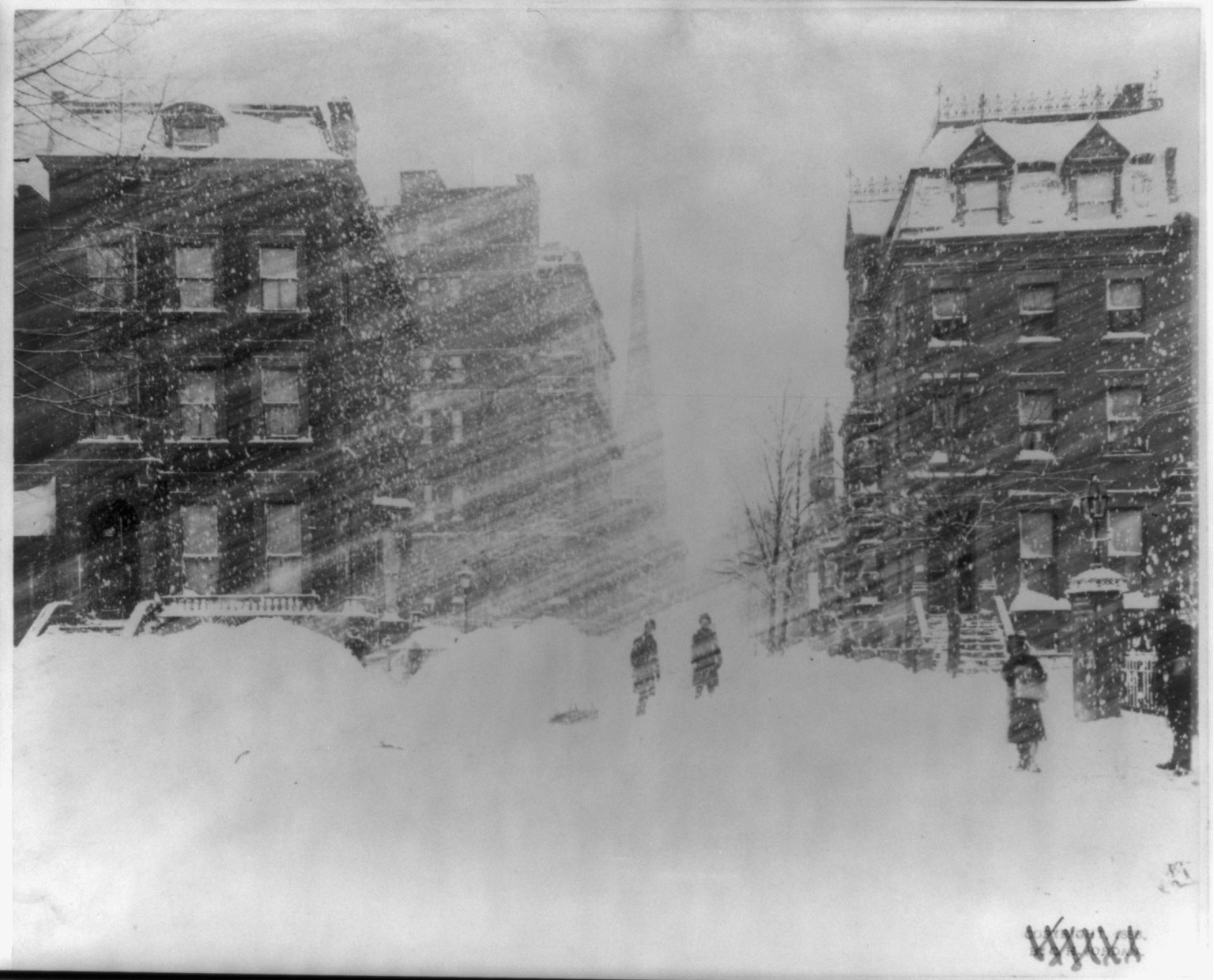
Nearly two feet of snow on hurricane-force gusts stopped the most modern city in America dead: els frozen mid-air, wires down, 200 dead. The case for going underground was settled in a morning.
The facts
- The dates
- March 11 to 14, 1888; in the city the storm broke after midnight on March 12
- The snow
- About 21 to 22 inches in the city, with 48 inches at Albany and 58 at Saratoga Springs
- The cold and wind
- From 33 to 8 degrees in a day, with gusts reported to 80 mph; drifts reached 52 feet at Gravesend, Brooklyn
- The dead
- More than 400 across the Northeast, some 200 of them in New York City, plus about 100 sailors in the wrecked and grounded shipping offshore
- The paralysis
- Every horse-car and elevated train stopped; the Stock Exchange closed for two days; the telegraph went down from the Chesapeake to Montreal
- The famous casualty
- Roscoe Conkling, once the most powerful Republican in the country, collapsed at Union Square after walking miles into the storm and died that April
On Sunday, March 11, 1888, it rained in a mild New York. After midnight the rain turned to snow, the temperature fell 25 degrees, and by Monday morning the most modern city in America did not work. Nearly two feet of snow came down on gusts reported near hurricane force, piling drifts that buried stoops and, out at Gravesend, reached 52 feet. The elevated trains quit with riders trapped between stations, where men lashed ladders together and charged a quarter a head for the way down. The telegraph, telephone, fire-alarm, and electric wires that webbed every street came down with the storm, and the city went silent to the rest of the country for two days. Some 200 New Yorkers died. The most famous was Roscoe Conkling, the ex-senator who had run the state’s Republican machine, who refused a $50 cab fare, walked some three miles uptown into the storm, and never fully recovered. What the storm buried, besides the city, was every argument against putting the wires and the trains underground.
In their words
The event in the voices and documents of the people who were there. Every source links out so you can check it.
-
Newspaper
The city’s entire surface transit, horse and steam alike, was gone by Monday.
Before the day had well advanced, every horse-car and elevated railroad train in the city had stopped running.
The New York Times on the morning of the Great Blizzard, March 1888
The Sun’s front page put the stranded at "Tens of Thousands of Passengers Caught Between Stations," and reported the going rate for a ladder rescue from the frozen els: "twenty-five cents for each descent."
Source: nycsubway.org (NYT, 1888) -
Newspaper
A city that believed it had beaten distance found itself unreachable for two days.
Within forty-eight hours the city was converted into an Arctic wilderness, cut off from all railway and telegraph communication.
New York Herald, March 14, 1888
The Herald also reported an East River ice floe that people crossed on foot to Brooklyn, and coal dealers who "took advantage of their necessities to extort double prices."
Source: MyInwood (New York Herald, 1888) -
Newspaper
The overhead wire thicket had been a civic argument for years. The blizzard ended it.
The morning after, the Times gathered the public verdict on the poles and lines the storm had torn down: all the electric wires, "telegraph, telephone, fire alarms, and illuminating," it reported, "must be put underground without any delay."
The New York Times on the storm’s lesson, March 1888
The same standstill on the els became the standing argument for an underground railroad: the subway plan came in 1894 and construction began in 1900.
Source: nycsubway.org (NYT, 1888) -
Document
The storm’s most famous casualty was one of the most famous men in America.
Roscoe Conkling, the former senator who ran the New York Republican machine, refused a cabman’s $50 fare at his Wall Street office, walked some three miles into the storm, and collapsed at Union Square. He seemed to recover, then died on April 18, 1888.
The death of Roscoe Conkling, March to April 1888
That $50 was surge pricing, about $1,280 in today’s money by WNYC’s math. Conkling, 58, decided to beat the storm on foot instead.
Source: WNYC -
Report
What "snow removal" meant before the machine age.
The city dug out largely by hand: an estimated 24 million cubic yards of snow, from streets also strewn with downed wires, shattered glass, and the waste of a horse-powered city.
The cleanup, March 1888
Baruch’s tally of what else was under the snow: 500,000 pounds of manure and 60,000 gallons of horse urine. The Gilded Age street was not romantic up close.
Source: Baruch College, NYCdata (disasters)
What people get wrong
-
The myth New York got four or five feet of snow.
What’s true The city’s fall was 21 to 22 inches. The four-and-five-foot memories are drifts and upstate totals: Saratoga Springs got 58 inches, Albany 48. The wind, not the depth, is what shut the city.
-
The myth Roscoe Conkling died in a snowdrift.
What’s true He made it indoors after collapsing at Union Square and lived five more weeks, dying on April 18, 1888 of the pneumonia and complications that followed the exposure. The blizzard killed him slowly, which is why his death became its symbol.
-
The myth The blizzard built the subway.
What’s true It settled the argument, not the schedule. The subway plan came in 1894, construction began in 1900, and the first train ran in 1904, sixteen years after the storm. What moved fast was the wires, which the city drove underground in the years right after.
What it changed
- The overhead wire thicket came down: the storm turned burying the electric, telegraph, and telephone lines from a debate into a schedule.
- It made the underground railroad argument unanswerable. The 1894 subway plan and the 1900 groundbreaking trace straight back to the morning the els froze with tens of thousands aboard.
- More than 400 people died across the Northeast, roughly 200 in New York, which still ranks the blizzard among the deadliest disasters in the city’s history.
- Conkling got a statue in Madison Square Park, blocks short of the home he never walked to, and every New York snowstorm since has been measured against 1888.
The city is still writing this.
Four centuries end at this morning’s news. The daily brief picks up where the history leaves off: what changed in New York today and what it means, explained by breakfast.
Free. One email each morning. One-click unsubscribe. Never sold.