
Lenapehoking & New Amsterdam · 1643-1664
Half-freedom in New Amsterdam
New Amsterdam's enslaved could win a conditional release called half-freedom, land included, their children not. Eleven men won it first, in 1644, on the far side of the wall.
The facts
- Who
- Eleven enslaved men held by the Dutch West India Company, among them Paulo Angola, Groot Manuel and Simon Congo, after 18 or 19 years of service
- The ruling
- The Council of New Netherland, under director general Willem Kieft, granted "half-freedom" on February 25, 1644
- The conditions
- An annual tribute in grain and a hog, labor for the Company on demand, and continued enslavement of the men's children, born and unborn
- The land
- Grants north of the wall that grew to more than two dozen parcels, roughly 130 acres, across what is now Greenwich Village, SoHo, Chinatown and part of the Lower East Side
- First grant
- July 13, 1643, to Domingo Anthony and Catalina Anthony, seven months before the Council's mass half-freedom ruling
- The end
- Land rights eroded under English rule and were extinguished by anti-Black legislation passed after the 1712 slave revolt
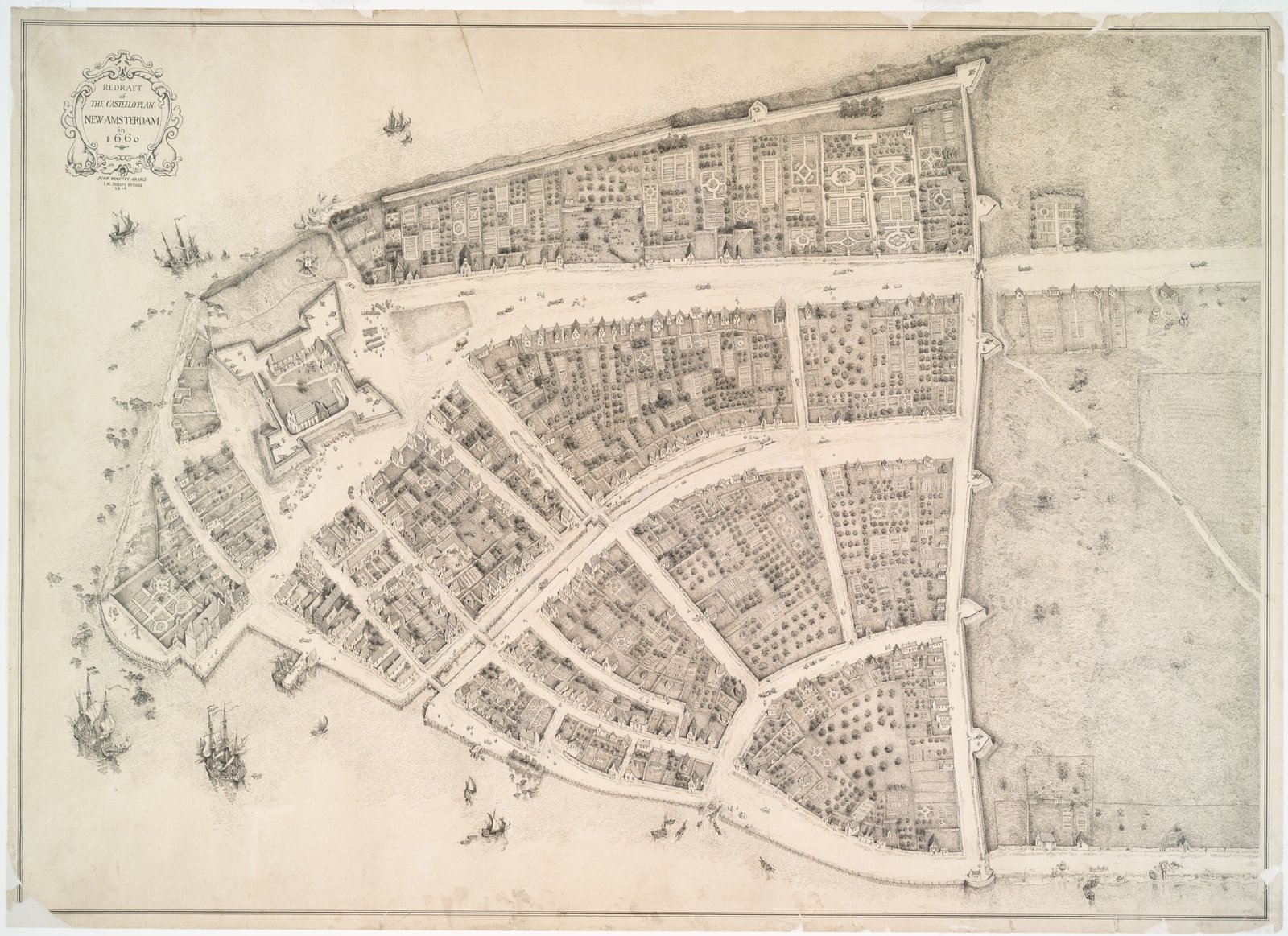
New Amsterdam's enslaved population helped build its fort and its wall, and eleven of them eventually won a form of release from it. On February 25, 1644, the Council of New Netherland, under Willem Kieft, ruled on a petition from Paulo Angola, Groot Manuel, Simon Congo and eight others who had served the Dutch West India Company 18 or 19 years. The Council granted "half-freedom": release from bondage for an annual tribute of grain and a hog, labor on demand, and continued enslavement of their children. Land came with it, plots north of the wall that grew, through grants dating to July 1643, into nearly thirty farms covering about 130 acres in today's Greenwich Village, SoHo and Chinatown. When English warships reached the harbor in September 1664, eight of the half-free petitioned the collapsing council for full freedom and got it, days before the colony changed hands. What New York did with that freedom afterward is the harder half: land rights eroded under English rule and were extinguished by the anti-Black laws after the 1712 slave revolt.
In their words
The event in the voices and documents of the people who were there. Every source links out so you can check it.
-
Document
The Council's own framing of the petition it granted is the only surviving record of how the case was argued.
We, Willem Kieft, director general, and the council of New Netherland, having considered the petition of the Negroes named Paulo Angola, Big Manuel, Little Manuel, Manuel de Gerrit de Reus, Simon Congo, Antony Portuguese, Gracia, Piter Santomee, Jan Francisco, Little Antony and Jan Fort Orange, who have served the Company for 18 or 19 years, that they may be released from their servitude and be made free.
Council Minutes, manumission ruling on the petition of Manuel de Gerrit and ten others, February 25, 1644
The same ruling set conditions: an annual due of "30 skepels of maize, wheat, peas or beans, and one fat hog," labor for the Company on demand, and continued bondage for the men's children.
Source: New Netherland Institute, "Half-Freedom" (Slavery in New Netherland digital exhibition) -
Diary
A Dutch visitor, thirty-five years after the half-freedom ruling and fifteen years into English rule, walked the same ground and described who was living on it.
We went from the city, following the Broadway, over the valley, or the fresh water. Upon both sides of this way were many habitations of negroes, mulattoes and whites. These negroes were formerly the proper slaves of the (West India) company, but, in consequence of the frequent changes and conquests of the country, they have obtained their freedom and settled themselves down where they have thought proper, and thus on this road, where they have ground enough to live on with their families.
Jasper Danckaerts, journal entry, October 6, 1679
Danckaerts was on his way north to Harlem when he passed the farms. Their occupants were descendants of the original half-free grantees and other free Black New Yorkers.
Source: Journal of Jasper Danckaerts, 1679-1680, ed. Bartlett B. James and J. Franklin Jameson, trans. Henry C. Murphy (Charles Scribner's Sons, 1913), p. 65 -
Document
A second-generation petition: a half-free man asking, decades after 1644, for a dead couple's orphaned daughter to be freed rather than inherited as property.
Petition. Domingo Angola, free negro, praying the manumission of Christina, a baptized orphan daughter of Manuel Trumpeter and Anthonya, his wife, both deceased negroes.
Petition of Domingo Angola, New York State Archives, series A1809
The 1644 ruling had kept the children of the half-free enslaved. Petitions like this one were how individual families tried to undo that clause, one child at a time.
Source: New York State Archives Digital Collections, "The Land of the Blacks" exhibit -
Document
The boundary language from one of roughly two dozen individual land grants issued north of the wall.
the Bowery and Rivington St eastward towards Allen St, and downward towards Broome St.
Land grant to Sebastiaen de Britto (recorded as "Bastien Negro"), March 26, 1647
De Britto received six acres on what is now the Lower East Side. Seven months later he married Isabel Kisana, from Angola, in the Dutch Reformed Church.
Source: Lower East Side Tenement Museum, "'Land of the Blacks' and Sebastiaen de Britto"
What people get wrong
-
The myth "Half-freedom" made Paulo Angola, Simon Congo and the other nine petitioners free New Yorkers in 1644.
What’s true Freedom was conditional and revocable. The Council's ruling required an annual tribute in grain and a hog, labor for the Company whenever it was needed, and it kept the men's children, born and unborn, enslaved. Full, unconditional freedom for some in the group came only in September 1664, days before the English took the colony.
-
The myth The eleven men's 1644 petition was the origin of every land grant in the settlement later called the Land of the Blacks.
What’s true State Archives records show the first grant, to Domingo Anthony and Catalina Anthony, was issued July 13, 1643, seven months before the Council's mass half-freedom ruling. Grants continued for two decades afterward; more than two dozen parcels, totaling roughly 130 acres, appear in New Netherland and early English land records.
-
The myth The half-free kept their land once New York became an English colony.
What’s true Some grants held for a generation. But English authorities pared the rights back after 1664, and the New York slave revolt of 1712 was followed by legislation barring free Black New Yorkers from inheriting real property, formally extinguishing what remained of the original settlement.
What it changed
- The half-free families' farms sat on ground that is now Greenwich Village, SoHo, Chinatown and part of the Lower East Side; a later Black neighborhood on the same streets was known as Little Africa.
- Landholding families built a shared cattle pen and helped raise the 1653 wall along the settlement's southern edge, the wall that gave Wall Street its name.
- The 1712 slave revolt's aftermath, which barred free Black New Yorkers from inheriting property, marks the point where the promise behind the original 1644 land grants was formally revoked.
- The African Burial Ground, used by New York's enslaved and free Black population through 1795, lies just south of the old settlement and is now a National Monument administered by the National Park Service.
- Historians still debate whether the settlement deserves the label "first free Black community in North America" over Fort Mose in Spanish Florida, founded under full rather than half-freedom roughly a century later.
The New York Shelf
Read the whole story
Paid links. If you buy a book through these links, Bookshop.org pays us a small commission and sends a share of the sale to independent bookstores.
-
The history
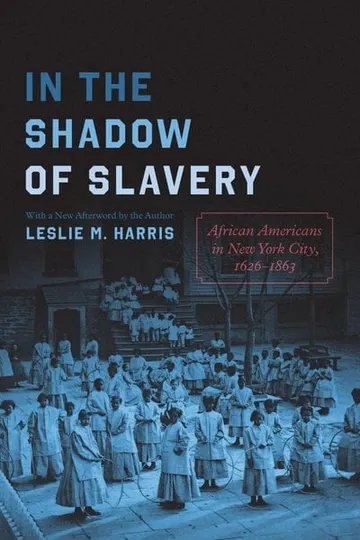
In the Shadow of Slavery (opens Bookshop.org)
Leslie M. Harris · 2003
Harris traces Black New Yorkers from the Dutch period to the Draft Riots, through enslavement, gradual emancipation, and the churches and neighborhoods they built.
-
The history
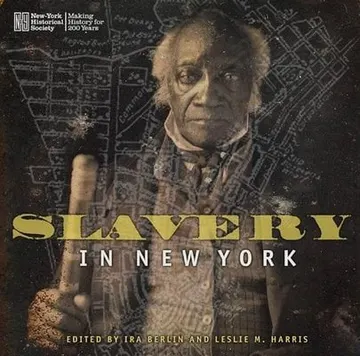
Slavery in New York (opens Bookshop.org)
Ira Berlin and Leslie M. Harris · 2005
Essays published with a New-York Historical Society exhibition follow slavery in the city from the Dutch era through emancipation in 1827, and its economic reach.
-
The history
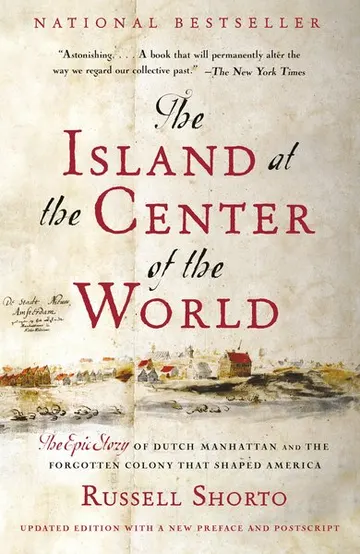
The Island at the Center of the World (opens Bookshop.org)
Russell Shorto · 2004
Shorto draws on the translated Dutch colonial records to reconstruct New Amsterdam under Peter Stuyvesant, and argues that its tolerant, commercial culture shaped the country.
The city is still writing this.
Four centuries end at this morning’s news. The daily brief picks up where the history leaves off: what changed in New York today and what it means, explained by breakfast.
Free. One email each morning. One-click unsubscribe. Never sold.