
The Modern Metropolis · 1892 to 1954
Ellis Island
For sixty-two years, the front door to America for twelve million people. The names were not changed here, and almost no one was turned away.
The facts
- Open
- January 1, 1892 to November 1954
- Processed
- More than 12 million immigrants
- Peak year
- 1907, with 1,004,756 arrivals
- Busiest day
- 11,747 people on April 17, 1907
- Turned away
- About 2 percent
- Descendants
- An estimated 40 percent of Americans have an ancestor who came through
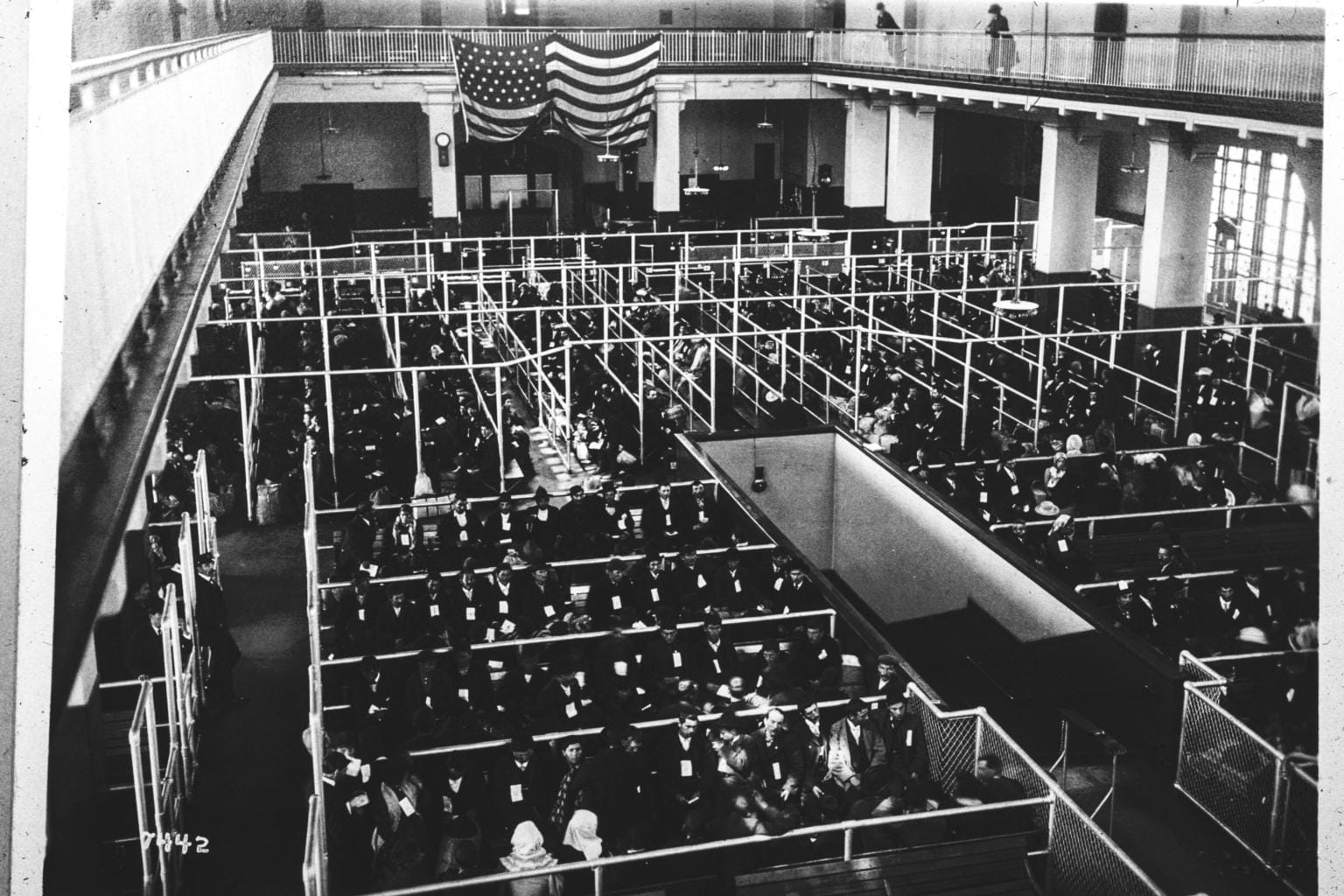
Steerage passengers came by barge to the island, climbed the stairs to the Great Hall, and walked into the busiest immigration station in the world. The climb itself was the first test: doctors stood at the top watching for a limp or a labored breath, marking coats in chalk and flipping eyelids with a buttonhook to check for trachoma. A legal inspector then checked each name against the ship’s manifest, written back in Europe. Most people cleared in a few hours. The popular memory of Ellis Island gets two big things wrong. Officials did not change anyone’s name, and the island was not a wall: only about two in a hundred were sent back. The nickname "Island of Tears" came from those two, and the families they split.
In their words
The event in the voices and documents of the people who were there. Every source links out so you can check it.
-
Memoir
Steiner, himself an immigrant, crossed in steerage on purpose to document the journey. This is the moment of entering the inspection hall.
With tickets fastened to our caps and to the dresses of the women, and with our own bills of lading in our trembling hands, we pass between rows of uniformed attendants, and under the huge portal of the vast hall where the final judgment awaits us.
Edward A. Steiner, On the Trail of the Immigrant, 1906
Source: Project Gutenberg (full text, public domain) -
Document
The buttonhook, a tool for fastening shoes and gloves, became the most feared instrument on the island.
To check for trachoma, Public Health Service officers would flip back immigrants’ eyelids using their fingers or a buttonhook. Trachoma was the most common reason for medical exclusion.
U.S. National Archives, "The Buttonhook," 2014
Source: National Archives, Pieces of History -
Document
Williams arrived to find filthy, exploitative conditions and posted enforceable rules of courtesy.
Immigrants must be treated with kindness and consideration. Any government official violating the terms of this notice will be recommended for dismissal from the service.
Commissioner William Williams, posted notice to Ellis Island staff, 1902
The exact wording varies between sources; the NYPL papers paraphrase it as "kindness and decency." The substance is firm.
Source: U.S. Bureau of Labor Statistics, Monthly Labor Review; NYPL William Williams Papers -
Document
She had sailed with her two younger brothers to rejoin their parents on the Lower East Side.
Annie Moore, age 17, of County Cork, arrived aboard the steamship Nevada and was the first immigrant processed at the new Ellis Island station, on January 1, 1892. An official handed her a $10 gold piece.
Annie Moore (1874-1924)
Her age is given as 15 by the Library of Congress and 17 by later genealogists; the 1874 birth year supports 17.
Source: Statue of Liberty-Ellis Island Foundation; genealogical research by Megan Smolenyak -
Document
The "six-second physical" is a popular shorthand. The inspection was fast, but not literally fixed at six seconds.
Public Health Service doctors watched each immigrant climb and move, then marked clothing with chalk letters for a suspected condition: E for eyes, H for heart, X for a suspected mental defect. About one in five was pulled aside for a closer look.
U.S. Public Health Service practice, about 1903 to 1914
Source: AMA Journal of Ethics, "Medical Examination of Immigrants at Ellis Island" -
Oral history
The Foundation’s oral-history project recorded nearly 2,000 arrivals, from 1892 to 1976.
There were people of all denominations, some on their knees making the sign of the cross, Jews in their prayer shawls, as we were passing the Statue of Liberty. It was the first time I saw it. It’s a sight I will never forget.
Lawrence Meinwald, who arrived from Poland in 1920 at age six
Reproduced in summaries of the collection; confirm against the original audio if quoting in print.
Source: NPS / Statue of Liberty-Ellis Island Foundation Oral History Collection
What people get wrong
-
The myth Officials Americanized immigrants’ names at Ellis Island.
What’s true They did not. Inspectors worked from ship manifests filled out at the European port, and interpreters spoke many languages. Name changes happened later, made by the immigrants themselves.
-
The myth Huge numbers were turned away at the "Island of Tears."
What’s true Only about 2 percent were excluded. The nickname came from the weight of detention and the roughly two in a hundred sent back, often splitting a family, not from a high rejection rate.
-
The myth Everyone who immigrated passed through Ellis Island.
What’s true First- and second-class passengers were inspected aboard ship and skipped the island. Ellis Island processed steerage, and it was one of several stations: Castle Garden came before it, Angel Island served the West Coast.
What it changed
- An estimated 40 percent of Americans can trace at least one ancestor through Ellis Island.
- The island grew from its original 3.3 acres to 27.5, almost entirely on landfill.
- It became part of the Statue of Liberty National Monument in 1965, and the Main Building reopened as the Ellis Island Immigration Museum in 1990.
- The surviving passenger records are now searchable online for the descendants of more than 100 million arrivals.
The New York Shelf
Read the whole story
Paid links. If you buy a book through these links, Bookshop.org pays us a small commission and sends a share of the sale to independent bookstores.
-
The history
American Passage (opens Bookshop.org)
Vincent J. Cannato · 2009
How Ellis Island ran from 1892 to 1954: the inspections, the officials, and the national argument about immigration. Cannato is a historian.
-
The history
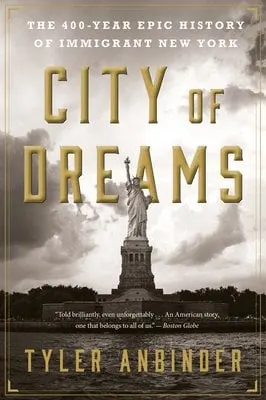
City of Dreams (opens Bookshop.org)
Tyler Anbinder · 2016
Each wave of arrivals, from the Dutch to recent immigrants, and how they found work, housing and political voice in the city. Anbinder organizes it by group.

The city is still writing this.
Four centuries end at this morning’s news. The daily brief picks up where the history leaves off: what changed in New York today and what it means, explained by breakfast.
Free. One email each morning. One-click unsubscribe. Never sold.