
The Modern Metropolis · March 25, 1911
The Triangle Shirtwaist Factory Fire
146 garment workers, most of them young immigrant women, died in eighteen minutes behind a locked door. The city never treated its workers the same way again.
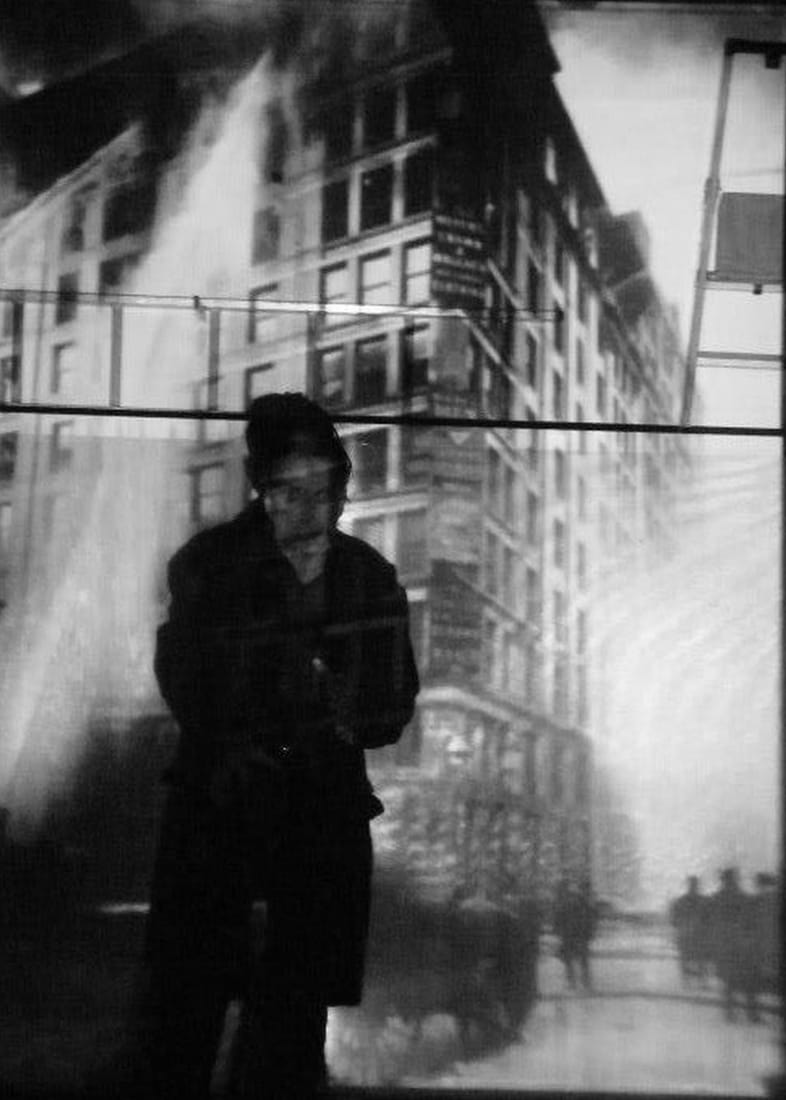
The facts
- When
- Saturday, March 25, 1911, about 4:40 p.m., near quitting time
- Where
- The Asch Building (now NYU’s Brown Building), Washington Place at Greene Street, Greenwich Village
- The dead
- 146 workers, 123 women and girls and 23 men, most Italian and Jewish immigrants aged 14 to 23
- How
- 62 jumped or fell to the street; the Washington Place stairway door was locked, the fire escape buckled, the elevators failed
- The owners
- Max Blanck and Isaac Harris escaped over the roof and were acquitted of manslaughter in December 1911
- The reckoning
- New York’s Factory Investigating Commission and dozens of new fire-safety and labor laws
It was almost quitting time on a Saturday when a fire caught in a scrap bin on the eighth floor of the Triangle Waist Company. Within eighteen minutes, 146 people were dead, most of them teenage immigrant girls. They found the Washington Place stairway door locked, the single fire escape buckling under them, the elevators able to make only a few trips. Sixty-two jumped from the ninth-floor windows rather than burn, and the bodies fell so fast the firemen’s nets tore. The owners kept that door locked to stop workers stealing thread. They were tried for manslaughter and walked free. But all of New York had watched its daughters die on the sidewalk, and the politics of the city turned on that block.
In their words
The event in the voices and documents of the people who were there. Every source links out so you can check it.
-
Speech
The "Uprising of the 20,000," the garment strike that came sixteen months before the fire.
I am a working girl, one of those who are on strike against intolerable conditions. I am tired of listening to speakers who talk in general terms. What we are here to decide is whether we shall or shall not strike. I offer a resolution that a general strike be declared, now.
Clara Lemlich, calling the garment strike, Cooper Union, November 22, 1909
The strike won contracts at most shops, but not at Triangle, whose owners refused the union. That refusal left its workers in the conditions that killed them.
Source: PBS American Experience / Jewish Women’s Archive -
Speech
Eight days after the fire, the labor organizer told a hall full of wealthy reformers that their sympathy was worthless.
I would be a traitor to these poor burned bodies if I came here to talk good fellowship. We have tried you good people of the public and we have found you wanting. The old Inquisition had its rack and its thumbscrews... the iron teeth are our necessities, the thumbscrews are the high-powered and swift machinery close to which we must work, and the rack is here in the firetrap structures that will destroy us the minute they catch on fire.
Rose Schneiderman, memorial meeting at the Metropolitan Opera House, April 2, 1911
She refused to thank the society women who had gathered to mourn.
Source: Cornell ILR, The Triangle Factory Fire -
Oral history
Perkins ran to the scene and watched workers jump. She became FDR’s Labor Secretary and a chief architect of the New Deal.
We heard the engines and we heard the screams and rushed out and rushed over where we could see what the trouble was... They had been holding until that time, standing in the windowsills, being crowded by others behind them, the fire pressing closer and closer.
Frances Perkins, who watched the fire from Washington Square, lecture at Cornell, 1964
The line often quoted as hers, "the New Deal began on March 25, 1911," is not actually in this lecture, though the sentiment is genuinely hers.
Source: Cornell ILR (Perkins lecture) -
Newspaper
The jury deliberated under two hours. Judge Crain had instructed that the owners had to have had personal knowledge the door was locked at that moment.
Triangle Owners Acquitted by Jury.
The New York Times, December 28, 1911
Outside the courthouse, victims’ families met the acquitted owners with hissing and cries of "murderers."
Source: Famous Trials (reprinting the 1911 Times) -
Testimony
The whole case turned on one locked door and the death of one worker behind it, Margaret Schwartz.
I believed that the door was locked at the time of the fire, but we couldn’t find them guilty unless we believed they knew the door was locked.
Juror Victor Steinman, after the acquittal, December 1911
The jury believed the door was locked. The law the judge gave them required proof the owners knew it in the moment, and so they acquitted.
Source: Famous Trials
What people get wrong
-
The myth The owners went to prison.
What’s true Blanck and Harris were acquitted of manslaughter and served no time. A 1914 civil settlement paid the families $75 per life lost, and the owners had collected insurance well beyond their losses.
-
The myth Frances Perkins said "the New Deal began on March 25, 1911."
What’s true That exact line is not in her actual lecture. The fire genuinely launched the labor reforms she carried into the New Deal, but the crisp one-liner is a paraphrase.
-
The myth The death toll was uncertain.
What’s true It was always 146. What stayed unresolved was the identity of six victims, finally named by historian Michael Hirsch in 2011, on the centennial.
What it changed
- New York’s Factory Investigating Commission, led by Robert Wagner and Al Smith, drove dozens of new laws: unlocked outward-opening doors, fireproofing, fire drills, sprinklers.
- Frances Perkins, who watched the fire, became FDR’s Secretary of Labor, the first woman in a U.S. Cabinet, and shaped Social Security, the minimum wage, and the 40-hour week.
- The garment workers’ union surged; the disaster vindicated the 1909 strikers Triangle had refused to recognize.
- The site is a National Historic Landmark, and a permanent memorial was dedicated there in 2023.
The New York Shelf
Read the whole story
Paid links. If you buy a book through these links, Bookshop.org pays us a small commission and sends a share of the sale to independent bookstores.
-
The history
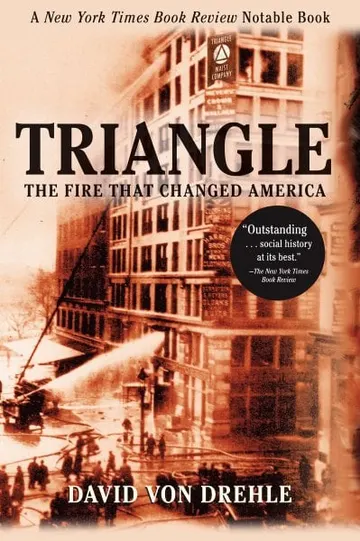
Triangle (opens Bookshop.org)
David Von Drehle · 2003
Von Drehle reconstructs the March 1911 factory fire that killed 146 garment workers, the manslaughter trial that followed and the labor laws that came after.
-
The history
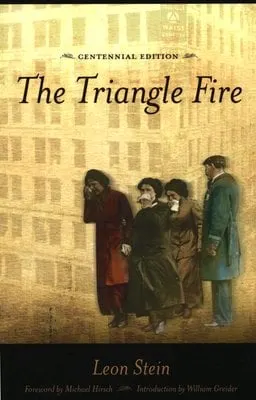
The Triangle Fire (opens Bookshop.org)
Leon Stein · 1962
Stein, a garment union editor, drew on survivors' accounts and the trial record to write about the fire, the owners and the labor movement around it.
-
The history
Greater Gotham (opens Bookshop.org)
Mike Wallace · 2017
Wallace picks up at consolidation and runs through the First World War, covering the subways, skyscrapers, immigration, labor fights and the birth of modern city politics.
The city is still writing this.
Four centuries end at this morning’s news. The daily brief picks up where the history leaves off: what changed in New York today and what it means, explained by breakfast.
Free. One email each morning. One-click unsubscribe. Never sold.